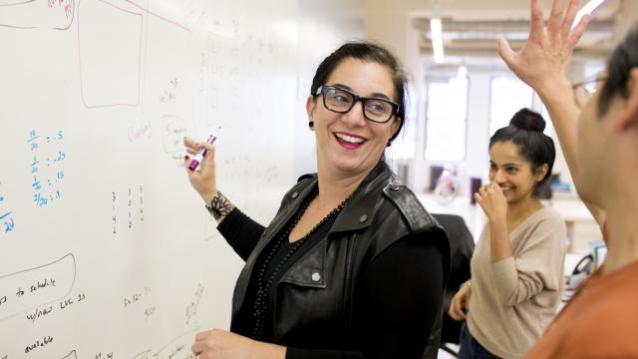
“Everything is a marketing campaign now, even policy ideas” – Renee DiResta Connecting Politics, Anti-Vaxxers & Social Media

Badass. Renee DiResta is badass. Not self-proclaimed badass. But like seriously badass. Click on that bio link in the previous line. Look for yourself. Then read the below. Seriously badass. Enjoy Five Questions with Renee. 

ReneeDiResta

Hunter Walk: You went from Wall St Trader to VC at OATV to operating side now at Haven, a logistics startup. Is there a consistent attribute underlying those different roles, or do they reflect changing perspectives on what interested you?

Renee DiResta: Some of it is changing perspectives, but the common thread is marketplaces. I started at Jane Street as a clerk, writing code to automate myself out of the boring parts of my job (basically, writing scrapers because there were no APIs). When I freed up time, I asked the partners if I could start attending the trading classes even though I hadn’t been hired into that role, and that’s how I became a trader. I was a market maker, so it was my job to build models to derive fair value for certain types of emerging market equity derivatives; it’s a fast-paced environment with incomplete information. I loved it…did it through the financial crisis and the European debt crisis. In 2011, the market became less hectic and I started getting interested in pricing private companies—even less information! This was before the Facebook IPO. I was really interested in Second Market and idea of a market to trade pre-IPO shares. So I switched careers into venture capital because I wanted to learn the ways of valuing private companies. I guess I kind of did, as much as one can; it took me awhile to get my head around the ad hoc nature of seed deal pricing. I started focusing on hardware because it made more sense to me, mathematically.

I would never have helped to found Haven without these experiences. I saw our hardware portfolio companies struggling with their supply chains; they were overly reliant on expensive air freight because the ocean freight market was so opaque. I saw them literally calling freight forwarders on the phone—basically the brokers of the freight industry—getting charged some unknowable markup. There’s no transparency, and a lot of variability, and as I started doing research I learned that this affected even the largest shippers. Matt, Jeff, and I believed that there was an opportunity to bring market dynamics and workflow automation to the freight markets…better visibility into prices, access to a broader network of providers, eliminating the human error component in order entry, etc. All things that happened on Wall Street while I was a trader, as tech became more prevalent in trading. And I love being on the operating side. I can personally make an impact in a way that I was one degree removed from as an investor.

HW: When you dove into the world of anti-vaxxers you encountered some really interesting conclusions about how extreme groups use social media effectively, and how traditional voices are getting drowned out. Can you share an overview of what you discovered?

RD: After the 2016 election this is going to sound obvious but: our social network framework has created an easily-manipulatable environment that allows the loudest voices to get the most attention, facts be damned. And plenty of people have known this for years. In 2015 when we started working on the law to eliminate vaccine opt-outs in California, it became pretty obvious that there was an asymmetry of passion on social channels that was pretty much the opposite of actual public opinion (which is 85% in favor of vaccination requirements for school). I reached out to Gilad Lotan and we decided to map the network, to look at message dissemination techniques. On Twitter, we saw a very small minority of prolific users who spent their days shouting about vaccine conspiracy theories, changing the specific thrust of their messages over time to appeal to other communities.

These accounts were longtime pushers of the “vaccines cause autism” trope, but as it became clear that was a failing strategy, they started to reach out to Tea Party-dominated Twitter hashtags, to cloak their true objections under more relatable concerns about “parental choice” and “government overreach.”  We saw specific verbatim message coordination across networks, including automation—bot and cyborg accounts. Some of it was of course real grassroots, but there was a fair amount of manufactured consensus, overrepresentation of certain niche points of view. 26% of the tweets in the overwhelmingly anti-vaccine Twitter conversation were sent by .05% of the participants (literally, 10 people, five of whom didn’t live in California). That’s not representative of reality, but most regular people aren’t on social channels talking about how they vaccinate their children. They just do it.

The other piece of the problem is harassment. After 2016, I think attitudes on that have changed too, because now it’s affecting all types of people. Twitter let some pretty terrible stuff slide as “free speech” out of some combination of idealism and laziness, and as a result, they allowed free speech to stifle free expression. A subset of the people opposed to our law, for example, turned to extreme harassment as they realized they were losing; they went after our families and children, started doxxing legislators and lobbyists, etc. This is not conducive to healthy conversations about ideas, or growing real grassroots activism on either side of the political spectrum. It makes speaking up a liability, and that’s terrible for democracy.

HW: And this “manipulation” is becoming more pervasive across sectors by groups who have different goals (financial gain, electoral influence, and so on). Are the platforms like Twitter just caught in the middle or is there more of a role for them to adjudicate?

RD: Everything is a marketing campaign now, even policy ideas—they’re just marketing campaigns for an issue. The power to influence opinions lies with those who can most effectively disseminate a message. We’ve democratized propaganda, and created dissemination channels in which it can be effortlessly delivered by fake people (bots, sockpuppets, etc). State actors and terrorist groups realize this, and so do political parties and corporations. We’re in the midst of an arms race; no one wants to be the one not using all of the tools at their disposal.

For some reason we continue to let our tech platforms pretend that they bear no responsibility for the current dismal state of affairs, and that’s just not true. They are responsible. As long as they monetize attention and prioritize engagement above all else, as long as their recommendation engines push people further into echo chambers and down conspiracist rabbit holes, nothing is going to change. At the same time, I believe that the engineers and creators of these products are fundamentally good people. This was not what they built for. Engineers and designers have a lot of power here, and I think design ethics is going to be an increasingly important priority for tech companies.

HW: Post-2016 elections you’ve also gotten involved with some campaigns to assist their tech efforts. How did that come about and did being “on the ground” make you more or less encouraged with regards to the way Democrats/Progressives will use tech in 2017, 2018?

RD: I’m a centrist—in San Francisco, that makes me the most conservative person in the room—and I’ve been disappointed by the rise of the extreme fringe on both sides. I think it’s directly related to what I’ve described above, a system designed to engineer virality, which is basically a rage machine at this point. We have to do better, and that includes doing a better job reaching all Americans with real, accurate policy messages about the issues that matter to them, giving them better ways to connect with their representatives and moving beyond sensationalist, expensive TV ads.

The 2016 election really galvanized the tech community and as a result, there are dozens of new entities that help people be meaningfully active—using their talents in marketing, engineering, design. I led digital teams for the Thompson and Quist special elections for Tech for Campaigns. The Thompson campaign in particular was incredibly tech-savvy; James Thompson really leveraged Facebook Live and Twitter to connect on an individual level with the people in his district. With these special elections, we’ve been able to try out new and innovative tech-mediated strategies that will be useful in 2018. There are also campaign-agnostic communities like Data for Democracy, which has projects on everything from race ranking to policy analysis to exposing disinfo campaigns. The DCCC and DNC are receptive to what we’re sharing back with them. They’ve made some powerhouse hires. It’s not a quick fix, but I’m cautiously optimistic.

HW: Is Silicon Valley now serious about increasing diversity, improving the experience for women in the community? What metrics would you look at to understand if change is real or just posturing?

RD: I’ve been amazed by the tech industry’s willingness to take an unvarnished look at itself. I think that folks who do the hard work on diversity in tech are having a meaningful impact in changing attitudes, particularly around sexual harassment. Lots of women in groups I belong to were DMing articles to each other after the recent stories broke, saying, “Can you believe this is actually out there now?” Going forward, it’ll be very difficult for firms that excuse bad behavior; I don’t think it’ll remain hush-hush any longer, and that’s a big deal.

Buzz and press coverage aside, picking the right metrics is important. Diversity experts have deeper knowledge of this than me, but I see it as a funnel, and it’s important to track trends at all levels, from top-of-funnel talent pipelines to increasing diversity in C-level leadership positions. In my early 20s as a trader (there are very, very few female traders), I once asked about industry outreach efforts to recruit more women and heard “girls don’t want to be traders.” I think Wall Street lags tech in awareness, though, and out here in SV I think that excuse is basically done. I’ve seen increasing numbers of women in venture capital in the six years since I’ve been in SV, including as partners at top firms. VC firms like First Round are building communities not just for their female founders, but for women in tech in general (which I hope translates to more women starting companies!). The benefits of diversity on the bottom line are inarguable. And on that note, Haven is hiring.

Thanks Renee! Follow her on Twitter

“We have a common philosophy that it all starts with people” – Heather Hartnett on Human Ventures, NYC’s Startup Studio

When I was about 7 years old, my parents told me that if I had been female, my name would have been Heather. So when Joe Marchese introduced me to Heather Hartnett for more information about the NYC startup studio they were cofounding, I was predisposed to feel a kinship. Heather isn’t just building Human Ventures to be valuable, she’s building it to be meaningful and enduring. I can see this in the people they bring onboard and the founders they work with. I’m lucky enough to be a small personal investor in HV and the Five Questions below will give you a sense of why I’m excited. 

Heather Disrupt 2017 2

Hunter Walk: Give readers a brief overview of Human Ventures and how you got involved.

Heather Hartnett: Human Ventures is what is now called a startup studio—a hybrid of early-stage VC fund and company builder. We’re based in the heart of New York City and our mission is to be the very best co-founder to the most talented entrepreneurs.

I started Human Ventures with initial backing and a push from a long-time friend and brilliant entrepreneur, Joe Marchese. Joe and I shared the same vision that we didn’t want to just add more money to the ecosystem. Instead, we wanted to create a fertile framework for builders to build, and to help bring valuable companies into existence. As you know, Megan O’Connor (now co-founder of our portfolio company, Clark) quickly joined us, and then Michael Letta, Human’s third partner and CFO/COO. Together we set out on this journey. After two years we now have an accomplished executive team, and will have 15 companies in our portfolio by the end of this year.

We have a common philosophy that it all starts with people (hence the name, Human). Our operational platform and valuable network help founders leverage their unique skills and form early teams to give them a distinctive edge in building industry-changing businesses.

HW: From my perspective, one of the biggest challenges with incubation is project lifecycle management. How do you decide that an idea should become a company, and have you had to kill any companies because they just weren’t working

HH: Fortunately, no, we haven’t had to kill any that have launched. However, we recognize and appreciate how early we are in the process. The bulk of the companies we’re working with are growing fast but are still fresh out of the gate.

Here are 3 ways we think about this:

  1. It’s important for us to have a person in place as early in the ideation process as possible. If we don’t have the right person (or two people) in place to drive an idea forward, we’re comfortable tabling it—we never launch a company without a founder in place.
  2. The founding dynamics and incentives mirror that of a company that is created on its own, but just with a lot more support and experience in place. Founders also get the benefit of learnings from their sister companies who often just went through the same challenge or opportunity a few months earlier.
  3. To increase objectivity, we bring in external investment early on so we’re not in the position of pricing our own companies. We sit on the side of the founder and we let the market value the company. Similar to the perspective that David Frankel takes in “I can grade you or teach you but I can’t do both.” This takes discipline, but we feel external validation is critical.

HW: Human Ventures is a close knit group—in the sense that many of the people involved as principals, founders are friends, spouses. How has this impacted the culture? Is keeping “business” and “personal” separate an outdated notion?

HH: Creating a deep sense of community and trust is very important for us at Human. In an industry where founders often burn out, can’t always be honest with how they’re doing, or feel deeply alone and in unchartered territory, it’s really empowering to work with people who you share your values. It doesn’t mean there isn’t constant pressure and competition, but in general, there’s something to knowing that you’re working with good humans that have your back. Especially when times get tough.

As far as my thoughts around working with friends and spouses, and the notion of business and personal merging; first and foremost the skills have to map to the job and every situation is different. I’m never quick to work with close friends or family for the obvious reasons. But when you can, and the trust is there, it can work very well. The simple question is, have you worked together successfully in a business situation before? If the answer is yes, having prior knowledge and experience of working with someone can be a huge advantage.

HW: Besides traditional financial metrics, how do you measure the health of Human Ventures?

HH: We’re very intentional about this. We spent a good amount of time on our company’s values and how we incorporate them into our hiring and operating plans. Ultimately, values dictate your culture and overall health as a company, so we’re deliberate about keeping each other accountable to them. We call it “Our Guide to Being Human” and in addition to measuring how we’re tracking against living those values, it also helps guide our bigger decisions.

From a network perspective, we measure how many quality founders we’re engaging and what our extended ecosystem looks like. We track how efficiently we can activate our network to build the right team and/or get expert help in areas where we don’t have in-house expertise. Another indicator that we use internally is the willingness of our direct and extended network to refer high caliber talent.

HW: Human Ventures does a good job of finding talented people outside of traditional tech backgrounds. When you’re talking with potential hires or founders, what qualities do you look for? Any favorite questions you ask them?

HH: ​This is a great question and one that speaks to how Human Ventures takes a different approach to other studios. We’re very interested in “the future of people,” which speaks to the name of our whole operation. How can you uncover the skills and motivations of a founder and early team members that might not be gleaned from their resume, their former industry, or the last title they held? In other words, are there non-traditional ways of evaluating an individual’s capacity that allows for skill mapping and personality matching? It’s been proven that skill sets, along with personality traits that work well together, make up the best performing teams. We have a framework that we use for bringing together our early teams and assessing execution ability. It’s early days, but we believe it’s core to the future of how well-rounded teams will and should form.

In a less methodical way, we look at qualitative traits as well. What is their tolerance for risk, desire to grow as a person, or influence in a particular sector? Our executive team has a lot of diversity in terms of background, so it naturally draws out different types of founder profiles. This requires different methods of evaluation—it has to go beyond the traditional tech profile and pattern recognition.

In terms of raw qualities, we like persistence, grit, and people who are keenly self aware. This one is really important, because it helps us build out a complimentary team. If you can’t articulate what you’re uniquely qualified to do, as well as where your weaknesses are, that’s a real flag for us.

Thanks Heather. Follow her on Twitter and check out Human Ventures!

Heather Cheddar tv

Sorry Idaho, Employee Noncompetes Are a Scourge

“This is about companies protecting their assets in a competitive marketplace,” says the industry representative for the incumbents. NYTimes Conor Dougherty covers the use of employee noncompetes in Idaho as a weapon in the conflict between local existing companies and startups. Residing in a state (California) where noncompetes are toothless, I was surprised to read that research suggests 1 in 5 American workers are subject to a noncompete.

What’s crazy about Idaho’s law is how far it tips against the individual. As Conor writes, Idaho “shifted the burden from companies to employees, who must now prove they have “no ability to adversely affect the employer’s legitimate business interests.”” What a chilling effect!

I can imagine a very narrow use case where a specifically skilled employee who has been exposed to R&D work receives additional compensation for agreeing to not work at a set of named competitors for a limited period of time. But the application of these rules to the average worker is crazy.

“Rather than going on the defensive, because that’s what a noncompete is, just go on the offensive and create a great environment so that people want to stay with you,” he [enlightened Idaho employer] said. “That makes you a better company in the end.”

Hell ya!


Three Questions Founders Should Ask Scouts Before Taking An Investment

[Stefon voice] “The hottest club in Silicon Valley is ‘Scouts.'” Yup, after Sequoia and a few others funds debuted a ‘Scouts’ program several years back, many firms have lined up their version. The format differs but let’s generally describe Scouts as, individuals using money fully or partially fronted by another VC fund to make investments in early stage companies with hopes of giving the sponsoring fund an advantage in leading a larger round for the startup later on. As Tomio Geron wrote in this week’s WSJ,

Screen Shot 2017-07-19 at 2.37.38 PM

At Homebrew, we don’t currently use Scouts, but generally welcome any investors into syndicates who can provide value to the founders. That said, I’ve got three questions that I recommend founders ask any angels participating in their rounds.

1. Are you a Scout?

You’d think this one is unnecessary but I’ve heard different stories from founders with regards to when individual investors disclose they’re investing someone else’s money. Sometimes not until the wire transfer is in process. Sometimes post-investment. From my perspective, a Scout should disclose upfront, either when requesting a first conversation about an investment or during that first meeting. Every fund says they tell their Scouts to disclose the relationship but I’m not sure it always happens in the same way.

If I were a founder, I’d ask pre-first meeting because I want to know going into a discussion what the motivations and objectives of an investor would be. When a venture fund approaches you, it’s safe to make the assumption they’re investing other people’s money. When an individual approaches you – especially a non-full time investor (Scouts are usually founders or industry operators) – it’s nature to assume the opposite, that they’re investing their own money. Best for everyone to understand this upfront.

2. Are you a Scout for multiple funds? Do I have the option of taking money from just you, or will you only invest from the Scout pool?

Yes, some people are repping multiple funds. The ties in Silicon Valley are complex! Understanding which pools of money a potential investor will be drawing from gives mutual clarity on expectations and goals. It’s also fair to inquire if an angel routinely draws from their own money or are they only investing from the Scout fund. With this information you as a founder can establish the guardrails with a potential investor. You can tell her, “look, I’d love to have you involved but only if you’re using your own capital. Is that possible?”

3. What information about this investment do you share with the sponsoring VC?

This is the most important question of the three. Information is power. If the Scout is passing along your email updates and investor updates to their sponsoring fund, you should know it. This can happen quietly without your knowledge, or because the sponsoring fund is a GP or LP in the Scout fund. Scouts are investing before their sponsoring fund would. For example, pre-seed ahead of a seed, or seed ahead of an A Round. There are other objectives for the sponsoring fund (building relationships with Scouts who could be advisors to their funded startups or future GPs at their fund), but the primary reason is dealflow, access, a first look.

We support mutual transparency during a fundraising process. When you’re out for that next round it really helps build trust if you can give an investor access to raw data, a narrative about what’s working and what’s not, and a sense of momentum. But you want to do this on your terms and timeline. If there’s a Scout on your cap table and you don’t know it, or don’t know what information they’re sharing – written, verbal or otherwise – it handicaps you as a founder. If you take money from a Scout, I think it’s perfectly reasonable to expect that Scout to signal to their sponsoring VC about how things are going. And as a founder, this is the risk/cost/benefit (depending on how you see it). I do not think it’s fair to have the Scout transfer founder updates or company information verbatim. Especially since it’s possible the sponsoring VC has an investment which might be competitive. As a founder you might think in general about not giving information rights or detailed updates to individual investors/Scouts if you’re not 100% confident in their transparency (although to be honest, I’d strongly advocate not taking money from any investor you don’t trust to begin with!).

So, overall the presence of Scouts is a GoodThing, in that it enables more people – especially those early in their career, women, PoC, etc – to become value-add investors in startups. As a founder just realize what you’re signing up for and make sure you understand what working with a Scout means.

Update 7/20: Sequoia’s Roelof Botha, one of their managing partners and the originator of their Scout program (and, disclosure, a grad school classmate of mine), notes that their firm doesn’t ask for information rights from their Scouts.

Podcasts Are Awesome But Are They A Business? Hot Pod’s Nick Quah Tells Me Some Stuff.

I love podcasts. Not just as a consumer but from a societal perspective because there’s so much about the medium which reminds me of other formats (text, video, music) where technology has played a significant role in helping creators explore their talents, build audience and make money. Nick Quah is a smart dude when it comes to podcasts and his newsletter is one of the places I turn for conversation about “non music audio.” Here are Five Questions with Nick about podcast present and future. 

profile pic

Hunter Walk: Can you give folks a little bit of background about how you got involved in podcasts and what you’re doing now?

Nick Quah: Man, where do I start?

I launched Hot Pod back in November 2014 which, if you recall, was around the time Serial’s first season was just about to go truly bananas. Back then, I was a bored kid itching to do something interesting — still am — and I started the newsletter off a few things: (1) I had been firmly in love with the medium for a few years by that point, (2) I began seeing some writing about podcasts that felt insubstantial, and (3) I’m generally interested seeing and thinking about things through the lens of business, structure, and all that kind of stuff. So Hot Pod, as a side project, was a product of those things, and to be honest, nothing’s really changed from that starting position.

To be concise with what happened after: the newsletter kept growing, and I kept working at it, and soon enough it just took over my life. I kept publishing the newsletter while I moved through other jobs (including a stint at an actual podcasting company, Panoply), and eventually, about a year ago, I started reckoning with the fact that I was spending more time working on the newsletter than investing sweat into my actual job. Figured it wasn’t fair to my employers, so I decided it’s best to go ahead and try to make this an actual low-overhead micro-business.

Thankfully, it’s worked out so far. I have a solid number of paying subscribers that gives my work a good financial foundation, and I’ve used that platform to add some other interesting projects on top: writing podcast reviews for Vulture, developing a print project with a friend, some research, considering more live events. It also really helps that the industry continues to be really interesting to me, and it’s consistently given me a lot of things to process and write about. I’m not… quite sure how things will shake out in the long run, and I do find myself itching to work with a team again, maybe in a non-media industry, but for now, this is where I am.

HW: Why are so many podcasts too long? Or more seriously, how do you think “podcast length” gets decided and will better analytics have an impact on format length?

NQ: Heh. Well, to address the initial semi-facetious question: whether we’re talking about a podcast or a magazine or a movie, things often feel too long when there’s an absence of sufficient editorial discipline to tamp down things like self-indulgence, amateurism, and the chaos of process. I put it that way because I feel like my own newsletter suffers from those things all the time, and I think it’s perfectly applicable to what you’re describing with podcasts there.

Anyway, more seriously: the way I see it, podcasts should be as long as they need to be in order to do what they want to do. Often times, when we talk about podcast length, I think there’s a tendency to be sort of overly structural about things… like we’re operating within a universe where there’s a golden length to be discovered and excavated through the power of data or something. But really, it all comes down to what the show is trying to do. For example, The New York Times’ The Daily has a really specific vision for how it fits into people’s lives—as a taut capsule experience for the morning commute, basically a morning vitamin that you down and go—and so the team there has really stuck to a user-first design strategy of being short and accessible, but impactful enough to make a lasting impression. But their success isn’t necessarily transferable to other projects, y’know? I’m often very happy when Aminatou Sow and Ann Friedman or Bill Simmons decide to go extra long with their podcasts, because they’re doing very different things: instead of designing a tight experience, they’re doing the work of creating really enjoyable experiential spaces that I want to wrap myself in like a blanket for hours and hours and hours.  

So I don’t quite see better analytics as establishing any direct impact on podcast length per se. Rather, what I’ll be watching for is how they impact the nature of the editorial choices being made. Some folks will gravitate more towards playing to the analytics, deploying various tricks to raise complete rates or push audiences to listen as far as they can go. Others will flip that relationship and use the analytics to improve their ability to achieve their specific goals — be it tell a longer story or fiercely serve the commuter. In a way, and to be clichéd about it, you could say that better data lets people be more of what they are: artists, opportunists, grifters, business people, whatever.

One other thing, and it’s just a rough sense: I generally think better analytics is a good thing editorially—despite whatever impacts it might yield for the advertising market—because it, like, brings a democratizing effect to craft intelligence. And so, and I’m just spitballing, I think it’s possible that we’ll see the proliferation of more “good” stuff. But I also have a sense that will come to the detriment of “great” stuff. I’m still thinking through this, and I’m looking a lot at what’s happening over in television for lessons here.

HW: Today’s podcast business model is largely ad support, platform sponsorship or audience patronage. Do you expect we’ll see more “consumer pays” models—whether it’s at the show/series level or a “Hulu for Podcasts” play?

NQ: Good question. As a rule of thumb, and after living through the Cubs winning last year (and, not to mention, that particular presidential election cycle), I try not to make a habit of thinking that a certain thing can’t happen. Which is to say, yeah, sure, of course we might see more paid models, some of which might even work. It’s not a question of whether it’s possible—because anything is possible—but it’s about the how, right?

But to put money down on the question: there could well be a paid on-demand audio service model, but I suspect it should look less like Netflix in 2017 and more like HBO in the 70s. Solve one unsexy mass consumer problem really, really well—I don’t know, highlight the really strong parts of the long-tail or fill-in a very specific underserved but well-hungered niche—and then work upward. As it stands, building a pay-walled podcast service and trying to compete on a quality level doesn’t strike me as a good strategy; you can’t account for the serendipitous great shit that’s going to pop up over the open ecosystem.

Could there be successful pay models for individual shows? Sure. Though, the actual structure of the model should depend on the show.

HW: What’s your sense of how the large media companies (NBCUniversal, Time Warner, Viacom, etc) are thinking about podcasts?

NQ: I have no idea. Big companies (and institutions) are so… opaque to me. It’s like asking what the Borg is thinking. That’s on me, though: I don’t have enough experience or formal training to think like corporations do. (Maybe I should go to business school.) Hell, I don’t understand why a company like Time Inc. is considering changing its name, or whatever.

But from my experience reporting for Hot Pod, my sense is that it’s all toes in the water. Podcasting is growing really quickly, sure, but right now it’s still peanuts compared to other sexier markets—VR, AR, China, blah blah blah— that are on the shopping menu for those corporations, and so I see limited incentive to either build a meaningful play or go for an acquisition at this point in time. I don’t know, maybe when the industry as a whole breaks half a billion. That’s not to say there hasn’t been activity, of course: EW Scripps did acquire Midroll, after all, and that seems to be working out.

HW: What should I be listening to right now?

NQ: I actually really love the first act of 36 Questions, Two-Up Productions’ follow-up to Limetown, which is a podcast musical. Get yourself some My Dad Wrote a Porno. Get on Dissect. And I’m really digging Tyler Cowen’s interviews. The dude is a machine.

Thanks Nick! Follow him on Twitter at @nwquah and sub to his Hot Pod newsletter.

“Their baseline knowledge of Silicon Valley probably comes from HBO’s Silicon Valley.” How Alyssa Bereznak Covers Tech for The Ringer.

My undergrad degree was in history, but I always qualify it as “social history,” which to me means not just focusing on “names, dates, wars” (aka high school history) but understanding the past through stories. Alyssa Bereznak covers tech for The Ringer and her reporting appeals to me for the same reasons. Alyssa doesn’t write wrote explainers about Instagram’s latest feature updates but she will go deep into the Plantstagram subculture. You can read her stuff here but before you click away, here are Five Questions I asked her:

alyssa

Hunter Walk: The Ringer isn’t a “tech site” but (kiss up alert), you’re one of my favorite tech culture writers. What assumptions do you make about The Ringer’s audience and how does this shape what you write about?

Alyssa Bereznak: Thanks Hunter! I usually only hear that from my mom. Since the Ringer is a pretty young online-only publication that caters to an entertainment-obsessed crowd, I assume two things about our readers:

They, too, are probably creatures of the internet.

Their baseline knowledge of Silicon Valley probably comes from HBO’s Silicon Valley.

In other words, anyone who clicks on a story of mine probably knows what it’s like to be a human online in the year 2017, but they only have a vague understanding of the forces and personalities that shape the tech industry. TechCrunch is probably not in their daily news diet. They don’t know what “due diligence” means. So I keep those two things in mind when brainstorming stories. I always try to approach my topics with the most human angle possible and maintain a good sense of humor about our odd dystopian reality.

Also, I don’t know anything about sports. PR people, if you’re reading this, please don’t pitch me sports tech.

HW: One of the reasons I enjoy your stories is The Ringer hasn’t (so far) focused on covering every breaking tech news story. Why do so many sites feel compelled to always put out their version of the story everyone is covering, even if they don’t have much new to add? Did you have to do more of this when you were at Yahoo News?

AB: I think mostly that’s a numbers game, which I totally understand and acknowledge as a reality of the current high-pressure media landscape, where an entire talented staff of writers can be replaced with a video team in one short memo. What makes less sense to me is the sheer lack of analysis, explanation or personality that goes into that kind of aggregation-based coverage. When Twitter rolls out a new feature with a comprehensive blog post detailing how it works, what’s the purpose of posting the same thing on your site with the same exact information? My theory is that there’s such a fear of missing a story that publications sacrifice quality by casting as wide a net as possible. Or maybe they’re too frazzled and exhausted. I’m lucky to work for a place that doesn’t think that’s the best strategy, and I’m grateful for it.

HW: While you’re currently based out of NYC, you grew up in Silicon Valley and your mother works at Apple. How did teenage Alyssa view the tech industry and how does that compare to your views now?

AB: Yes! My mom works at Apple. (I always try to feed her wine so she’ll tell me secrets but the woman has spy-level interrogation training.) My dad’s a patent lawyer. I grew up in Sunnyvale and went to the same high school as Steve Jobs. Tech was a huge part of my life as a teen. Our campus wasn’t far from Apple’s HQ, and I remember the second the latest iPod came out we were all toting it around in our hoodie pouches. I’d spend hours on AIM chatting with friends and crushes. I watched as catfights broke out in my friend group over Xanga posts and MySpace flirtations. Tech was our essential social glue. It raised me and my friends and we loved it. And it was also the reason all of our parents were employed. I’m not sure if that was entirely exclusive to growing up in Silicon Valley, but maybe it was amplified.

I’ll be honest, as a teen I was too busy being completely self-absorbed to care about how tech companies shaped our society. I was just living proof that it was happening. But my fond memories of tech from that era inform my coverage. I’m a lot more critical and cynical these days, but I always keep in mind that this stuff is a source of joy for so many people.

HW: When a source leaks news to you, how do you decipher what their motivation might be and how does your estimation of their trustworthiness factor into how you use that information?

AB: I usually map out all the players of a story in my mind and try to fill in the blanks. Even if I have sympathy for a source and believe what they’re saying, I ask for receipts in the form of emails or screen shots or whatever they can give me. I try to corroborate statements with as many people as possible. It’s less about trustworthiness to me than it is the ability to confirm a person’s experience. People tend to be unreliable narrators, and talking to as many sources as possible will always guarantee a more nuanced telling than if you just take someone at their word.

HW: Ten years from now are you still a reporter?

AB: I’m not good at anything else, so I really hope so. Here’s to hoping a bot won’t be able to do my job better than I do by then

Thanks Alyssa! Follow her on Twitter @alyssabereznak.

“A natural, & healthy, tension between myself & the people I write about.” How The Verge’s Casey Newton Handles ‘Tech Friends.’

My friendship with The Verge’s Casey Newton started where 90% of his relationships do: on Twitter. Casey’s coverage of tech is opinionated, but not cavalier, and even empathetic when appropriate. As a result I’m a “Casey Completist” – I try to read everything he writes because if it’s something that caught his eye, it’s likely that I’m interested as well. Casey was kind enough to join me for Five Questions where he said not to “pull any punches….”

casey

Hunter Walk: The way media companies make money (or measure success) can sometimes be inconsistent with what I think leads to good reporting. For example, page views and being “first” versus in-depth analysis. How does The Verge measure a reporter’s contributions? How do you know if you’re doing a “good job?”

Casey Newton: When I think about my job performance, I’m generally thinking about two things: impact and audience. Impact is the harder of the two to measure, but it shows up a few ways. Are your competitors aggregating your work? Are they crediting you for your scoop? Are they sharing your analysis on Twitter and Facebook? Nuzzel has become an excellent tool for measuring impact, for this reason — it shows you which stories were so good that competitors felt compelled to share them. Good stories have impact in other ways, too: they result in companies changing their policies, or bad actors losing their jobs. But my basic belief is that it’s not a good story until someone who doesn’t work with you, or for the company you are writing about, tells you that it is.

The second dimension is audience, and it’s a tricky one. On one hand, chasing page views for their own sake often results in terrible work. On the other hand, no one likes shouting into an empty void. So I try to look at it in the aggregate—is my audience growing over time? Does that audience include the people I respect the most, whether they be fellow journalists or people in the tech world? As long as that number is creeping upward, I feel good about what I’m doing. (I’d note that The Verge has never evaluated employees on page views or video views, for these reasons—although like any publisher, we celebrate employees when they get a big win.)

HW: Continuing with the “making money,” many media companies now have quite valuable event businesses alongside their sites. These conferences rely upon getting the big names to attend for interviews, while at the same time, the publications should be covering these people with a critical eye. Does this concern you? How can objectivity be maintained?

CN: It’s a fair question, and something we do think about—particularly as we think about ways The Verge might do events in the future. Fortunately we have a great model in how to proceed with the Code Conference, which our parent company, Vox Media, acquired in 2015. Walt Mossberg and Kara Swisher envisioned their events as first and foremost as acts of live journalism—which means no scripts, no panels, and an expectation that the speakers would make news. Anyone who agrees to come to Code knows they could be in for a grilling, and yet the caliber of speakers has only gotten better over the years.

This is tricky to replicate—Walt and Kara are the best in the business. But they have absolutely provided a model, and I can’t imagine using another one. Most of the tech conferences I’ve been to don’t offer much in the way of insight; they seem to be designed primarily to protect and promote the companies that they’re showcasing. An easy thing that most conferences could do, and do not, is to leave time for unscreened audience Q&A. The audience questions at Code often lead to answers just as revealing as the ones that from the moderators.

HW: Similarly you’re a conscientious reporter but also maintain friendships with many of the people in our industry. Has that put you in awkward situations? You and I are pretty close—how do you think I’d react if you came out with a really negative piece about one of our portfolio companies?

CN: Not well! It helps that Homebrew is generally focused on the enterprise, which I write about less. [hw note: we do plenty of consumer! And I wouldn’t be angry if I thought it was tough but fair. That’s your job.] But yes, this puts me in awkward situations all the time. After I criticized bots on Facebook Messenger a few times, David Marcus stopped meeting with me. I interviewed Jack Dorsey a couple months after writing a piece headlined, “Nothing Twitter is doing is working.” (It didn’t come up.) I wrote a piece about abandoning Evernote, a company where I had become friendly with some folks who used to work there, and they messaged to remind me that they still have stock in the company. Somehow I think they’ll scrape by.

Another venture capitalist who I really like and admire yelled at me recently at a dinner his firm had invited me to that I am too negative. This came a few weeks after a PR person told me that I “criticize a lot of people’s babies.” I took this more as a statement of fact than a complaint about my work—it’s in the nature of what I do to evaluate products. This creates a natural, and healthy, tension between myself and the people I write about.

When you live in San Francisco, inevitably you become close with people in tech. But generally speaking, the more I write about your company, the less likely it is that we will be friends — while you’re working there, anyway.

HW: As part of your career at The Verge you’ve moved between reporting and editorial roles. Which do you enjoy more? Are you doing both now?

CN: I try to spend as much of time as I can writing and reporting. Writing makes me happy; managing people much less so. And fortunately my bosses at The Verge have gone out of their way to let me do as much writing as I want. But having been at The Verge since the site was 18 months old, I’m often involved in conversations about new projects we’re considering. I love that aspect of my job, and would never want to give it up.

Right now my main contribution as an editor—outside of editing five or so stories a week—is to participate in a weekly meeting we call Office Hours. Each week, three or four of our 70-plus editorial employees meet with our editor in chief, our investigations editor, and myself to talk about stories. We ask them about the big swings they’ve always wanted to take, help them to flesh out their ideas, and then offer resources to make them happen. We’re only a month in, but the conversations have been great and the stories are promising. It feels like a great use of my time.

HW: When a source leaks news to you, how do you decipher what their motivation might be and how does your estimation of their trustworthiness factor into how you use that information?

CN: You should know your source’s motivation, because it can speak to their trustworthiness. Sometimes they’re excited to share something with you; sometimes they’re mad at their company and want it to do better; sometimes they’ve left the company and want it to suffer. But in all cases they can still be wrong, and it’s why we seek a second source to confirm what we have heard. The best defense against untrustworthy sources is always, always to get more sources.

But I’m not in the camp that believes a source’s motives must be pure for their leak to be publishable. Our loyalty should be to the news, even if it’s of unseemly provenance. There’s a tough-to-attribute quote I learned in journalism school and I am still fond of it: “News is what somebody does not want you to print. All the rest is advertising.”

Thanks Casey! You should all follow him on Twitter.

“When there is pain in America, we see more volume.” Crisis Text Line, Tech & Trump.

When and how did I first meet Nancy Lublin, CEO/Founder of Crisis Text Line? I don’t recall but I know that once I got introduced I held on and wouldn’t let go. Because Nancy is always moving in interesting directions with compelling missions and people around her. Some of this velocity can be attributed to her New Yorker residency but the majority of it comes from her heart, which is like some superpowered, perpetual motion machine. Here she answers Five Questions…

nancy lublin

Hunter Walk: Can you give folks a quick overview what Crisis Text Line does and how it started?

Nancy Lublin: Sometimes products have unintended consequences. I was the CEO of DoSomething.org. We were texting with about 2.3 million young people every week. Huge open rates (97%?!) and super strong response rates (about 200k in each campaign) but every week we’d have a couple dozen “out of flow” messages. That’s normal in customer feedback land—but these messages were all personal, asking for helping with personal crisis like bullying or crystal meth. We were handing out hotlines numbers and referring folks elsewhere. Then we got a message that made me think differently. The message said “He won’t stop raping me. Its my dad. He told me not to tell anyone. R u there?” (Can you imagine?!) We gave her the hotline number for RAINN. And we never heard back from her. (I’ve actually tried calling and texting her. It’s now been almost 6 years. No word back.) Within weeks, I was like, “If they are going to share stuff like this by text, let’s build a hotline by text!”

HW: The tech infrastructure needs to be reliable—you’re dealing with very personal and often time-sensitive issues. How does this shape the infrastructure you’ve built and the engineering team you have in-house?

NL: I started with people I knew and trusted. First two hires were a CTO and Chief Data Scientist and they were out of DoSomething.org. They spent a few months traveling the country, looking at existing hotlines and typical user challenges, tech infrastructure, etc…

You start cheap. You hack your first system together. So, yeah, that meant we used a lot of Drupal. So much of who we are today we owe to Chris Johnson, the founding CTO. Chris built our original stack by himself. He was dev ops, front end, back end, etc. He owned the product pipeline. When we were a year old, we only had 3 devs—largely because he worked 24/7 and put so much heart into things. Lots of people talk about founders—and founding tech teams (or, more likely, individuals) don’t get the love they deserve.

Now our dev team is ~12 plus product and a data team of 4. (We’re looking for additional senior backend devs, fyi.) The messaging is built on top of Twilio and the CRM is Salesforce. You can see the rest of our stack here: https://stackshare.io/crisis-text-line

HW: Supporting others through difficult problems is noble but can also take its toll. How do you assess health of the team and make self-care a priority as well?

NL: Huge huge part of the culture. There are structural things—like quarterly reviews, weekly all-team check-ins, free Soul Cycle classes, nicer office space than you would expect for a not for profit, blah blah blah. Every tech start up has this. More importantly, supervisors (full-time staff with a masters degree in a relevant field like social work or psych) are half our company—and our purpose is to support 3,500 volunteers who do the counseling. So everything we do is about supporting caregivers. They ARE our users. We’re not selling toilet paper or helping you find Chinese food at 2 a.m. What we do is empathy. So we talk about words, best practices, new studies, news items, etc all day long. We’re in the business of self-care. As a company, we make it possible for Empathy MVPs to do their thing. We are in AWE of these supervisors and crisis counselors.

HW: Have teens been impacted by the election and the political rhetoric? Has there been a “Trump-effect” for Crisis Text Line?

NL: The lack of civility. The anti-Muslim and anti-immigrant policies. The nationalist rhetoric. The threats of homophobic policies. This talk affects everyday Americans.

On election night, we saw 8x normal volume for a couple hours. It was mostly LGBTQ people using the word “scared.” Immigrants and children of immigrants worried they would be deported. And, sexual assault survivors asking if they should bother going to the police or continuing with court cases in a political climate where a president admitted to grabbing women.

When there is anti-Muslim policy and rhetoric, we see spikes in everyday American Muslims feeling anxiety, bullying, and depression.

So, yes. We have been busy. When there is pain in America, we see more volume.

HW: Social media can be a very challenging place for teens. Do you feel like the CEOs of platforms like Facebook, Instagram and Snapchat are interested in creating more positive environments for teenagers? Do you actively try to engage their product managers with feedback?

NL: No. I don’t think any of the social media or search companies is doing enough. We have engaged with many of them—and it is a struggle to get them to make mental health a real priority. Committees and press releases are not the same as protecting user data, acting quickly in the face of imminent risk, and spending money on solutions.

Thanks Nancy! And everyone can donate to Crisis Text Line.

Harassment in Tech: Getting Beyond Words & Committing to Action

Brave women and tenacious reporters. Those are the people responsible for the escalating conversation about sexual harassment in the tech community. And while it might be satisfying to see a handful of perpetrators publicly identified, the New York Times’ Katie Benner rightfully points out that it’s not just a case of a few bad apples:

“It felt like I had flipped over a healthy-looking log to find decay and bugs underneath. The story wasn’t just one man abusing his power; it was an entire problematic culture.”

Now it’s up to all of us to decide what next. Do we just tweet angrily and go back to status quo? Or will we see real commitments made, especially by those who today hold power and wealth? Being an optimist I believe we’re going to minimally see adoption of new policies aimed to prevent the most egregious abuse from occurring and proactively increase the cost of being an asshole abuser.

There are a number of groups working on different approaches – Homebrew is participating in some and happy to sign on to others. Josh Constine of Tech Crunch was one of the first to step up and start gathering input for a document he published today called “A Template for Investor/Founder Sexual Harassment Policy.” As Josh notes in his accompanying OpEd:

…traditional harassment law does not adequately shield founders since they are not technically employees of the venture capitalists. To fill this gap, venture capital firms should adopt formal investor/founder sexual harassment policies that can be consistently enforced. To support the creation of these policies, a diverse group of whistleblowers, entrepreneurs, funders, and activists have collaborated…

I contributed to the effort and am pleased with the first version, but also know that these are living documents. Josh is very open to your feedback so please do read the documents and send any notes his way.

This summer we’ve already seen several venture funds impacted seriously by the allegations but the real tribute to the women speaking out is what does the environment look like a year from now. Honor them by committing to change, not just outrage.