Hey Tech Industry, Let’s Focus Less on UBI & More on Minimum Wage, Portable Benefits & Vocational Training

Lots of continued buzz these days in technology circles about Universal Basic Income because it’s assumed UBI is the best (or only) solution for a future where automation and AI dramatically shrink the number of jobs available. Although the American economy has already experienced a pretty significant shift in jobs over the past half-century towards roles that are thought to be less exposed to these risks, there are many signs of economic dislocation among the middle and lower classes today.
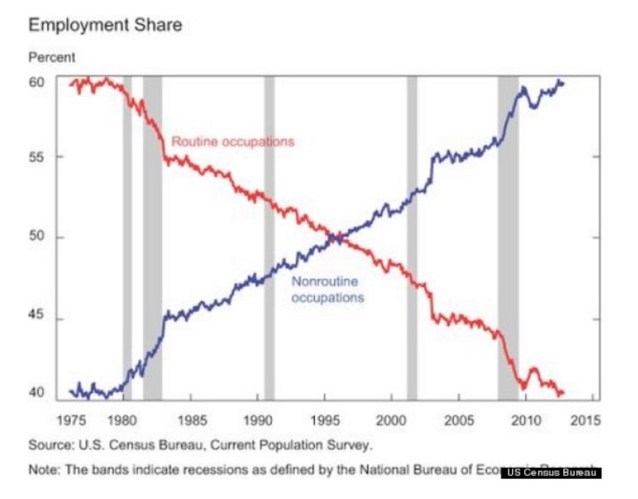
photo (4)

I’m actually quite bearish near/medium term on UBI as the right solution. Not because of any philosophical opposition and certainly not because I think it’s economically impossible, but rather because UBI tends to ignore the self-worth aspect of a job. We’ll make the numbers work far sooner than we’ll be able to change the societal aspects of how, in our culture, your job is a source of identity, pride and connectedness. My best guess is that any UBI initiative is going to need to coincide with a pretty dramatic and sustained cultural shift where we start to value other ways of contributing — volunteerism and civic participation, artistic expression, mastery of skills outside a work environment.

Large portions of America right now doesn’t believe the institution of government works for them or respects them. And our current President is exploiting this feeling to further suggest government is broken, perhaps irreparably. In 2018 and 2020 the Democrats need to unify behind a platform that is aggressively worker-friendly. We’re not going to navigate further technology-driven disruptions unless our country’s citizens believe we’re doing it together. Otherwise I fear we’re going to continue to break apart or regulate away innovation and put the US economy at risk of missing the coming advances in robotics, AI, automation and bioscience.

The technology industry is no longer an underdog. It’s a giant. A clumsy giant when it comes to fully understanding the attention and skepticism our power is attracting. For both moral and strategic reasons, we should be lining up to support progressive politicians on three main platforms.

  1. Increase the minimum wage to $15. That’s the message – $15. If you end up indexing that geographically against cost of living, that can be figured out in the details. But the top-line message is $15.
  2. Portable benefits cosponsored by public and private (health, disability, unemployment, etc). Your safety net isn’t tied to employment, it’s tied to citizenship. And businesses will pay their portion proportional to the percent of hours or income they provide.
  3. Vocational training. Rethink government-subsidized student loans and employer tax breaks to provide incentives for continuous upskilling of employees. There are going to be jobs, we just can’t always predict the skills needed. So let’s rebuild our education system to think about keeping people employable.

I’m also a strong believer in small business (with an emphasis on women and non-white entrepreneurs who traditionally haven’t been supported in wealth creation), immigration (especially into America’s colleges and universities), collective bargaining via unions and simplified tax codes. I lack expertise in these policy areas generally and also acknowledge there’s always a study or think tank which argues the other side of any of these issues. But at both a system-level (what set of changes do we need to make in concert) and at an emotional one (what is going to bring us back together), this is where I land.

If we can get behind a small number of  understandable and implementable benefits for the majority of American workers I believe we can cross party lines and unify those who feel destabilized by wealth inequality. And with that renewed trust and new leaders, we can create the foundation to longterm implement UBI or other more radical notions. But we can’t start there today and we can’t get there if we don’t do something now.

“Convince Me” said the Investor. “No” said the Founder.

It’s in a founder’s natural disposition to want to convince people of their point of view. And while engaging substantively with those who disagree is often an excellent way to both stress test your assumptions and increase your ability to tell your story, figuring out when to stop and disengage is critical for your productivity and sanity. Especially during fundraising.

Earlier this summer an engaging and forward-thinking founder told me a story from her in-process seed fundraise. Operating in a technology market that most would consider nascent, she had encountered a variety of responses to her pitch. Spoiler alert, more than enough were positive and she soon closed an oversubscribed round, but of course she also encountered rejection. We talked a bit about what she’d learned from those conversations and then the founder confided her most useless investor meeting to me.

“We sat down to discuss my company and he basically said, ‘I don’t think your market is going to exist. Convince me.'” Her response? “I told him I didn’t want to work that hard, and wrapped up the meeting.”

You know what? She was right. With some additional context, it was clear this wasn’t going to be the right investor for her company. He had no experience or basis for his assertion, just wanted to test her and/or establish a position of power in the discussion. This wasn’t a thesis defense. This wasn’t 15 minutes she’d finally finagled with a respected CEO in her industry. This was a man who, despite agreeing to take the meeting, established within the first few minutes of their conversation that he wasn’t someone who was likely to end up on her cap table and even more importantly, probably someone she didn’t want there. And she respectfully but firmly made a judgment call to not throw good time, and good energy, away.

So maybe pause this afternoon and think about one employee, one customer, one investor who is not critical and the source of disproportionate stress for you. And say Bye Bye Bye….

Screenshot from Bye Bye Bye (cover)

Fake Cues: Why The Next Photo Innovation May Be Helping You Tell a Lie

I want to share something which might be a bit unsettling – whenever I’m looking at you, I’m judging. Whether it’s in person or a static photo. I just can’t help it. It’s how I’m wired. By the way, it’s how you’re wired too. Perhaps our most basic survival skill is the near constant assessment and reassessment of other people based on their facial structures, their demeanor, slight changes in their movement. Which makes one wonder: can I “hack” this evolutionary necessity and influence the way you react to me?

For example, “microexpressions” are defined as “brief, involuntary facial expression shown on the face of humans according to emotions experienced. They usually occur in high-stakes situations, where people have something to lose or gain.” Perhaps you remember “Lie to Me,” the Tim Roth tv show where he played the world’s leading expert of microexpression-reading (now THAT would be a good LinkedIn Endorsement).

Screen Shot 2017-09-18 at 2.27.58 PM

But it doesn’t even require the fidelity of a realtime interaction for our monkey minds to start forming an opinion of someone else. All it takes is a face, even a static picture or artistic representation. Did you know we typically find facial symmetry more attractive because it potentially signals high breeding status? Side note – I’m fairly certain I’m asymmetrical AF.

So when hearing that the new photo sharing app Polygram reads the facial reactions of the viewer to tell you whether they liked or disliked your photo, well, that set off a bunch of ideas. We’ve undoubtedly already trained machine learning models to predict the “attractiveness,” “honesty” etc of people depicted in a photo. What happens when we start running this software not just in post-photographic analysis but in photo creation and editing? For example:

  • Selfie mode of a camera could let you select what emotions you want to provoke in the average viewer, give you some basic facial motions to mimic and then shoot a burst of photos, selecting from the burst the pictures which are most likely to work.
  • Photoshop could have buttons for “honesty,” “attractiveness,” “happiness,” etc and move your facial bits around in the smallest ways needed to “enhance” this aspect of your person. The changes likely wouldn’t need to be very significant – they’re called “microexpressions” for a reason.
  • Run software against models in commerce site, Tinder profiles, realtor photos and so on. ID any photos where the viewer would have real but imperceptible negative reaction. Prime them to buy, to swipe right.

So yeah, if software is going to help us read emotional reactions you can be sure it’s going to be used to manufacture them as well.

The Markets Ignore Inputs But Over Time, Not The Means

When asked for advice about a career in tech my feedback varies based on the individual’s goals but always ends with “…you can recover from any failure except one where you ruined your reputation.” Basically, trying to make sure that the desire to succeed, to impress, doesn’t overwhelm someone young in their career and cause them to compromise their ethics or values.

My friend and frequent co-investor Semil Shah wrote a good post this weekend called The Market Ignores Inputs. He writes,

Screen Shot 2017-09-18 at 10.33.55 AM

Absolutely true. Satya and I often describe how we’re thankful of the solid personal relationships we maintain with our investors and the shared values, but also know that ultimately our returns are the primary point of evaluation for the continuing business relationships.

The majority of investors I respect (Semil included) are output-focused but with a clear and consistent morality. For them the ends don’t justify the means, if that includes operating in a manner which is poisonous, ethically troubled or illegal. And it’s not about getting cute and trying to avoid knowing (ie “The doctor turned around so he could have deniability“). The Hippocratic oath of Venture Capital extends to helping founders maintain their true north, sometimes in the face of immense pressures and economic consequence. That’s an input you don’t compromise on.

Thinking About Bodega

As investors, we hope to help founders see around corners in order to assess and predict outcomes. Startups, especially early stage startups, are in the weird position of simultaneously trying to reduce known risks while embracing new risks. Today, one of our portfolio companies launched and was met with a strong, unexpected reaction, one I didn’t anticipate. This post is primarily about trying to understand that lack of anticipation on my part, and secondarily, providing some insight into why I believe in this company.

The company is called Bodega and their goal is to use technology to extend commerce to spaces where today you can’t put a store, or where an existing impersonal vending experience can be improved upon. Bodega’s vision is that these flexible devices can do several things at once (and here’s some more in their own words):

  • Provide better item inventory driven by local preferences, data analysis and curation
  • Support not just sales, but item rental, item exchange and so on
  • Be price competitive with delivery-service alternatives
  • Give store owners, property owners and individual entrepreneurs a chance to run a micro-business in an updating of the classic vending model

Bodega’s vision is not, and has never been, to compete with or replace the urban corner store. Bodega doesn’t want to disrupt the bodega. Some instances of today’s press coverage suggested that element, a soundbite which, exacerbated by Bodega’s naming, pissed people off as another example of tech startups being at best tone-deaf, and at worst, predatory. This article in Forbes explains Bodega well while appropriately critiquing the challenges they face in succeeding. We – and the other investors – committed capital, sweat and reputation behind a team that absolutely is working on a problem that matters to them and we believe can be meaningful to customers. And that’s the founder-market fit we seek.

So, About Our Name is CEO Paul McDonald’s explanation and introspection of the Bodega brand. Let me tldr by saying I agree with Paul’s commitment here to listen to and understand the feedback. And I believe they want to build a durable and thoughtful company where the decisions they make – brand included – represent their values.

But even though I looked at this name for several months pre-launch, why didn’t I anticipate the ways it could be interpreted? When I first heard it my biggest concern was, would anyone outside of NYC understand it? The early part of my childhood was in Queens, NY and bodegas were beloved, but did it translate outside of the five boroughs? The team’s market research suggested that it did – and in doing so they also spoke with consumers of different ethnic and cultural backgrounds.

Once that research came back positive, I was sold. It didn’t occur to me that some people would see the word and associate its use in this context with whitewashing or cultural appropriation. I heard it in a different way than some others are hearing it today. And that leaves me wondering why, because as an investor, and even more importantly as a human being, it’s an awareness that I need. So like the founders, I too want to listen and better understand the lines between homage and respect versus exploitation and insensitivity. Today tells me it’s a personal blindspot and to assist founders, to help them see around corners, I need to see clearly.

The Bot Registration Act of 2017 Could Improve Twitter For Us Humans

This sounds like an X-Men storyline, but Twitter needs to ask all bot accounts to register as such & then badge. Bots can be very useful but users should know they’re following a bot & bots should follow certain ToS. Treat bots like a developer ecosystem, not like user accounts.

Twitter hasn’t been able to effectively police their bot ecosystem – I don’t know if it’s will (desire) or way (ability, prioritization) – but it seems that they’d want to understand what percentage of their activity is machine-driven versus accounts piloted by actual human beings. The company’s policy lead published some general “we take bots seriously” thoughts earlier this summer but the post doesn’t clarify whether Twitter believes bots should be identified in a consistent user-facing manner. One of my favorite Bot-ologists, Renee DiResta, also recently suggested that bot accounts be labeled with a robot emoji, or some similar demarcation in the name or bio. (In that article Renee also distinguished between Bots and Cyborgs, both automated accounts but where the latter spoofs human behavior).

So want to follow a bot which tweets whenever NYTimes Maggie Haberman publishes a new article? Awesome. Whenever USGS detects a big earthquake? Yes! Which combines two current news events into a single headline? I don’t, but you do you. These and many more wonders exist on Twitter, but without a Bot designation and Bot directory, who knows what the average user assumes. It also gives Twitter license to shut down Bots which don’t register and more easily monitor account behaviors. As it stands, who knows what percentage of Twitter accounts are bots and what impact these bots are having on user experience. Well, I guess we’re incrementally answering this question without Twitter’s help….