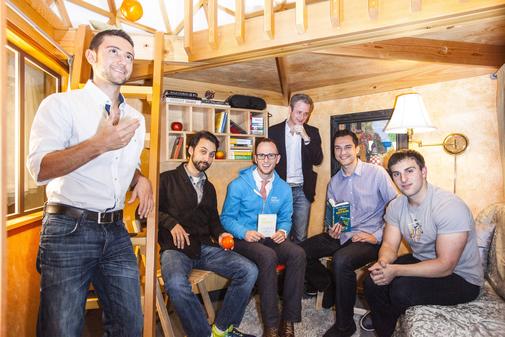
April 26th, 2013 was the day we closed Homebrew’s initial fund and we consider it our ‘birthday.’ The firm’s why and how were previous blog post topics and I won’t rehash them here, but first I want to share my 2013 Homebrew ‘premortem‘ with you.
When Satya and I started Homebrew together it was with full intention to be our ‘last career,’ what we’d be doing for the next 20 years or so. And if this *wasn’t* the case, my POV was it would be explained by one of these three reasons:
I didn’t like venture
Satya and I didn’t get along
Satya and I weren’t good at our jobs
So where are we now, with approximately 2,500 days of evidence?
Well, turns out I don’t generically like venture *but* I do love Homebrew. That is, it’s difficult for me to imagine being part of someone else’s fund. Even with the firms I respect tremendously, I have little desire to be the third, seventh or 14th partner around their table. I like our size, our strategy and the shared, equal responsibility Satya and I have to deliver against our promises to founders, LPs and one another.
And my relationship with Satya? It’s great – the whole is greater than the sum of its parts. Partnerships are dynamic and neither of us take the harmony for granted, but I’d be very surprised if there was ever an issue between us that could cause Homebrew to dissolve prematurely.
Number Three, are we any good? There’s a tendency to pronounce victory prematurely in our industry. Here’s how I define GOOD in venture: multiple consecutive funds where you’ve beaten your benchmarks while employing a repeatable strategy. By that measure it’s too early for me to answer but we’ve gotten off to a nice start. I’m confident that founders and coinvestors trust us. The founder feedback surveys we run every other year via a 3rd party give us positive indications that we’re living up to expectations (and of course, always a few things we could do better). Entrepreneurs are our customers and they keep us in business.
We’re investing out of our third fund now (which should take us to 2022) and have a solid group of institutional LPs backing us. Our first fund has already returned over its original principal to investors and we’re fortunate to have quite a bit of value still on paper (which we never assume means anything until it’s liquid). So by my own criteria, I’m not yet ready to say we’re “good” — won’t know that until mid-decade – but I can say we’re “not bad.”
Some of you know I have the Homebrew logo tattooed on my right shoulder. I did this to capture the creation of something meaningful. Thank you to Satya, our team, the companies we’ve backed, the coinvestors who work with us and our partner LPs for being the meaning behind the ink.
(Part 2 of this post will be responding to my AMA tweet and I’ll try to get it out within next few days. thanks for patience)
How do you value a human life? Planet Money takes us through the economists’ lens with a history lesson on how this questions has been answered in public policy debates over the past several decades (which is different than say, damages for wrongful death lawsuits). Bunch of new information for me including:
“There’s a rule that any federal safety regulation that’s going to cost more than a hundred million dollars a year has to pass a cost-benefit test. So, for example, seatbelts that beep at you – how much would it cost to install beeping seatbelts, and how many lives, in dollars, would be saved by it?”
“We do not adjust the value of statistical life for age. That means we don’t have a senior discount. That also means we don’t have a baby boost or child boost. It’s the same number, whether you’re 2, or 42, or 82. And I think a lot of people can see the problems with that.”
Matt has run WordPress/Automattic as a distributed team since the very beginning, even eliminating a beautiful SF office to ensure there wouldn’t be an implicit status bias towards “remoting” from SF. So I consider him one of the most thoughtful leaders when it comes to these questions, having accrued his “10,000 hours” of time on the issue (plus generally being a smart fellow).
This post is a short summary of a concept he covers on Sam Harris’ podcast, modeled after the five levels of self-driving autonomy (although it kind of also reminded me of Buddhist practices). Level Zero is a job which cannot be done today unless you are physically present and Level Five is… well, click through and read.
Twilio’s CEO Jeff Lawson should be included in any discussion of “who are the most impressive startup CEOs of the last decade.” Helped invent the commercial cloud API as part of the developer stack, took his company public (currently $15b market cap) and leads boldly and outspoken with values/culture. So I’m going to pay more attention to his lessons learned over the last few weeks than your Twitter bon mot. This interview is part of ExtraCrunch [paywall]. I’ll tease you with the ending paragraphs:
“I miss seeing people,” he says. “I think a lot of folks’ lifestyles are going to actually adopt more virtual work. I wouldn’t be surprised if we all come back and people are more likely to take a day or two a week and decide to work from home. We’ll know how it all works; it won’t be mysterious or scary, or like someone’s not showing up. It’ll just be… natural.”
“I wouldn’t be surprised,” he continues, “if there are some employees who say… ‘you know what? I actually really liked that. I don’t want to go back to the office.’ And you know what? I bet that’ll be okay.”
“I think there will be some folks who just can’t wait to return to the office — and that’s fine too!”
The only hesitation over including this beautifully written profile is the flinch I sometimes have when a protagonist isn’t in the position to give consent (Lee, the third founder of Cloudflare who is suffering from dementia). But it’s clearly done with love and caring, and the participation of his friends and family. I’ve met Lee’s cofounders Matthew and Michelle and I read this story twice – first as a Cloudflare history and then as an individual’s personal journey. Both were valuable and impactful.
I’ve mostly resisted the online tech conversations around “COVID will change [X] forever,” although I do especially love the ones which are basically tells for the individual’s true id (“i think post-COVID, polyamory is going to be really popular”). BUT I have dived deeply into the parenting conversations around “what is this doing to our kids?”
Obviously – as with all things with child-rearing – there’s no consensus. No one’s situation is exactly the same – a high school senior who just had their prom and graduation canceled is going to be different than a kindergartener who likely won’t remember any aspect, at least of this spring. Of course a family where someone has been laid off, or even worse, are dealing with the grief of losing a family member or close friend, may never be able to forget April 2020.
Personally I’m trying to treat this as an opportunity for my elementary school child. An opportunity to talk about our family coming together to keep one another, and our community, healthy. An opportunity to reinforce values of citizenship and leadership. An opportunity to nag about hygiene habits, creativity and self-instruction.
But each of these are on a spectrum. Go too far and I risk raising a fearful child, who loses her love of travel, OCDs about the last time she washed her hands and has difficulty attaching to others. And this is coming from a dad who defines “success” as my daughter eventually goes to therapy for something less serious than the reasons her parents do (ie I don’t believe you raise “perfect” children; you raise loved and resilient children).
So I begin each day, or week, and ask myself ‘what lessons do I want our daughter to take away from this week?” Plus ‘what lessons *might* she take away that I don’t want her to learn?” And then we do our best.
Our friendship began as many do – in a bar a few days after I’d been told that Lenny (a) just left airbnb and (b) was smart. Upon receiving the tip I clicked over to his Twitter profile where I saw that indeed he had left airbnb and that he was clearly super duper smart because he already followed me. A DM-slide and poof! cocktails and product management war stories ensued. In the time since he’s written some really wonderful posts and now a newsletter that’s going paid subscription, so seemed like an opportune time to ask him Five Questions...
Future’s So Bright….
Hunter Walk: So like, we’ve been friends for a year now. I went back and checked and it looked like I Twitter stalked you when you left Airbnb. Before we jump into Present Day Lenny, can you share how you initially got involved with Airbnb and, leading the witness, had you intended to stay as long as you did?
Lenny Rachitsky: I have this memory I’ll never forget of sitting in an early Airbnb all-hands looking at a big ass Airbnb logo (the old one) projected on the back wall, and thinking to myself “wait, how the hell did I end up at Airbnb??”
I was CEO of a little startup (Localmind) which we started in 2011, and things were going great. Growth was up, we were regularly getting featured in the App Store, and we were just about to kick off our seed round. But when Airbnb can knocking, we quickly realized that our most likely long-term outcome was going to be an acquisition, and that we couldn’t think of a single better company to end up at. So we sold.
When our team came on board, I quickly moved into product (I was an engineer up to that point), and held on for dear life for seven years.
One of my favorite memories from the early days is of Joe talking to an engineer/designer who was working on an update of the homepage literally a few days before a major launch. She was asking for feedback on what she thought was a complete homepage. Instead, Joe offered, “build something the internet has never seen before.”
And the funny thing is that she did (a sweet parallax’y hero image deal). That moment is actually a great microcosm of Airbnb. Never settling for good enough, always looking for ways to push further, and expecting the very best from everyone.
Did I intend to stay there for seven years? Hells no. When I started, I gave it a few years tops. But man, it’s a tough place to leave.
HW:What’s your decision framework for how you choose to spend time these days? I know you’ve done some advising and angel investing. But there have been some fun side projects too with regards to personal interests.
LR: My simple strategy for this year of exploration (which I’m so incredibly fortunate to have) has been to spend as much time as possible on things that give me energy. And as little time as possible on things that don’t. That’s it.
Though my original plan after leaving Airbnb was to start a company again, through this process, I discovered two things:
What I don’t want to do: Specifically, become a full-time VC (no offense Hunter), write a book, or start a product management training course. These are things that folks keep suggesting I do, but I do not enjoy them and am trying hard to avoid sliding into these default paths.
What I do want to do: I’ve discovered the things I enjoy most, at least for now, are writing, angel investing, and advising. So I’ve been trying to build a life where I can do those things.
As a result, these days, I spend about a third of my time advising, a third investing, and third writing.
HW:Ah yes, your writing. I’ve loved the newsletter and am glad to see you’re really committing to it with a paid subscription tier. I’m sure it was already opening doors for you professionally so what was behind starting to charge? Starting to build an income again? Signaling worth for the content? Challenging yourself to up your game?
LR: Folks seem to think I’ve had a well-thought-out plan with this newsletter. Honestly, I’ve been figuring it out as I go along.
I first started writing as a way to get learnings out of my head, before I forgot them. Then, as people started asking me smart questions about things I didn’t have great answers to, it gave me an excuse to go learn more myself (and have better answers). So I embarked on some in-depth research projects (e.g. marketplace growth), looped in smarter people on topics I have little experience on, and collaborated with other great publications to reach new audiences.
Why’d I decide to start charging? For a very simple reason: I want to avoid getting a real job. I’m trying to see if I can make a real living doing this eclectic combination of writing, investing, and advising. It’s a life experiment! Plus, there’s a really neat flywheel between these three things that’s become a huge bonus.
HW:Does this also mean you’ll have a budget to get some custom illustrations from your wife? Along this same timeframe I’ve gotten to know you, she published a best-selling book. What has riding along that experience been like?
LR: If only budget was the reason she doesn’t help me with my newsletter design 😂 She’s definitely got better things to do, plus she tries to avoid the tech world as much as possible.
But, I’m glad we’re clear that Michelle is the real star of our family. She’s as talented as she is modest, and I couldn’t be more proud of her. If readers don’t already follow her on IG, you’re making a big mistake.
Watching her publish her book (excellent reading for the sheltering lifestyle btw) was an illuminating experience. It’s partly what convinced me NOT to write a book. For her, it was a life goal, but the economics are ridiculous, and I’m convinced that for what I’m doing, investing that time in a paid newsletter is a much higher ROI use of time.
HW:I’m sure there are new grads and folks early in their tech careers for whom you’re a role model. What’s the advice you’d give someone now – and has any of that been changed by what’s currently going on with COVID19 and what the world might look like on the other side of this?
LR: This may be the first time anyone has called me a role model, so I have to let that process for a few days.
Some timeless advice I come back to when wondering what to do:
Do great work, create value, and good things will happen.
Spend as much time as possible on things that give you energy.
Work at the intersection of (i) things you enjoy doing, (ii) things you’re good at, and (iii) things that other people want.
Beyond that, for people early in their career, I would suggest optimizing for “variety of experiences.” Do as many different kinds of things as you can. Not only does trying a bunch of things help you find what you enjoy doing most, but also later in life you’ll find that many of the things you learned early on will be essential puzzle pieces in the work you end up doing. I’m pretty sure Steve Jobs said something similar, so it must be true. Explore, tinker, and take risks!
And finally, for the post-COVID19 world, my general take is that it’s going to further accelerate software eating the world (if that’s even possible), and so there’s even more reason to guide your career towards tech. At least the early part of your career. That decision early on for me, to get into software development, was the one thing allowed me to have this freedom to take time to explore and new paths. I’ve been so unbelievably lucky.
Thanks Lenny! I’m a happy paid subscriber to Lenny’s Newsletter and recommend you check it out as well (there’s a free tier too).
Earlier this month I finally reconciled a conflict that challenged me since COVID really crashed our shores in early March. Basically that it’s ok to both feel fortunate that we’re staying-at-home together as a healthy family with more resources than the average American, while at the same time acknowledge and honor the anxiety the situation is causing me.
Wanting to get my daughter back to school where she is able to learn, develop and explore. Wanting to support the founders we backed as people (not just investments) who are confronted now by market forces for sure, but also needing to knit a social and emotional infrastructure to help their teams. Wanting to sit next to my partner Satya at Homebrew HQ, not just Zoom from my dining room. Wanting to not hold my breath when someone walks by me, even if there’s six feet of separation.
For a few weeks any time those needs came into my head I pushed them aside, embarrassed that this was where my mind was going while people lost their jobs, suffered from a horrific virus, or any number of other more substantial dislocations than we’d encountered. So we gave to different charities (support FrontlineFoods) and checked in on friends with difficult situations, because those were good legitimate things to do.
But I wasn’t sleeping well. One night I fought vampires. Then Thursday it was some weird scenario where I left early from a friend’s wedding and couldn’t get back into the venue when I felt ashamed to have ditched. Then there was that one with the tentacle porn… nah, not really that one, just wanted to see if you were still paying attention.
When people would ask “how are you holding up” (or whatever basic inquiry you’d start with before jumping into the meat of the Zoom), my standard response was bravado and apology. “Great, really lucky. I know there are so many people suffering.” And it was true but only a half-reveal. So in one particular conversation I didn’t stop with that explanation but added on, “…still at the same time I don’t want my kid to have a childhood shaped by this experience. And I want to be giving great advice and counsel to our CEOs but in some cases we’re just going to have to figure it out as it evolves. And my puppy peed on the floor and I don’t know if she’s just mad at us or if something is wrong. And…” Well, it didn’t go on forever but you get the sense.
Then my conversation companion paused and shared his own version of what had been troubling him. And it was just as messy, and dumb, and serious, and trivial. And he was happy to be able to shed the “I got my shit together. Wartime CEO.” suit for a second and just be human. And I started having versions of this conversation with more people. And I was no longer battling vampires or missing weddings in my sleep.