Teaching my daughter that ‘adventure boo-boos’ are part of life
I come from a family of flinchers. Well-intentioned of course but with an instinctual urge to ask “is that safe?” before proceeding. Perhaps Darwin favors this trait in humans and long ago the majority of my look-before-you-leap ancestors did not fair so well.
But when we had our daughter, I wanted to find a new intermediate point between seeking absolute safety and Wile E. Coyote. Some parenting guides suggest that asking “are you ok?” when a child falls down actually encourages them to feel *not* ok because it increases the alarm or reinforces they’ll get pleasurable soothing if they show distress. [Lest people think that I stared silently at my toddler when she tripped on the sidewalk, I substituted “you are ok!” as an assurance.] And so Adventure Boo-Boos were born.
We don’t recall when Adventure Boo-Boos officially debuted as description but it likely coincided with the debut of my daughter’s enthusiasm for climbing very high up on playground equipment or trees. Soon scrapes, bumps, skinned knees and similar were deemed “Adventure Boo-Boos” — to be celebrated not feared. Make good choices and if you still fall, the abrasion was a form of epaulette, recognizing your life experience.
Our family was a few months into Adventure Boo-Boos when we were strolling down Valencia St one weekend afternoon. Passing a streetwear shop our kid paused, noticing the television set up inside which was playing a loop of skateboarding videos. She walked in and placed herself on the couch, evidently attracted to the stunts. I sat down next to her and started explaining what she was seeing.
It was the epic 1999 X Games (coincidentally held in San Francisco) and Tony Hawk performing the sport’s first ever 900. The 900 refers to a 900 degree airborne spin, 2 1/2 rotations. As shown in the clip below, Tony tried the trick a number of times during the performance, all unsuccessfully, until he finally nailed it.
Each failure resulted in some degree of bump, bruise, or fall. After a few of these my daughter pointed to him and said “Adventure Boo-Boos?” Yup, Adventure Boo-Boos for sure, I told her and then we watched him end with a victory. She clapped. I smiled.
Parents live for these organic teachable moments so I considered it a karmic sign when the next day my friend David tweeted about fundraising for the Tony Hawk Foundation. After a quick DM exchange and small charitable donation, a signed skate deck was on its way to my house. We hung it in our breakfast nook, where it remains today.
“Astrid. I get adventure boo-boo’s too! Tony Hawk”
Why the next 6–12 months will be the best time in a decade for startups to hire
Our YOLO Economy New York Times’ Kevin Roose labeled the new attitude sweeping workers in certain privileged parts of the economy.
But for many of those who can afford it, adventure is in the air.
One executive at a major tech company, who spoke on the condition of anonymity because she was not authorized to talk to the media, said she and her husband had both been discussing quitting their jobs in recent weeks. The pandemic, she said, had taught them that they’d been playing it too safe with their life choices, and missing out on valuable family time.
I’ve seen this in my own circles as well. Whether it’s moving to a new geography for a fresh start (for some, maybe just an Adventure Year) or leaving a safe but stagnant career, the “I’m starting a new company/open to a new gig” inbounds are up since Jan 1.
But it’s not just a new appreciation for the preciousness of one’s time and focus after a year of social distancing. We’re also seeing people vote with their feet towards companies which share their values and away from companies that, in their mind, violated a social contract. The company’s business matters too — the agriculture, health care, financial empowerment startups in Homebrew’s portfolio are all telling me about an increase in candidates who mention the mission as a reason they’re attracted.
And oh my goodness, we’re going to see a lot of transitions as companies head back from health-required distancing and settle into a longterm decision about work. Back in the office, hyrbid, fully remote. There’s surely going to be 5%?, 10%?, 20%? of teams for which a CEO’s decision won’t match with what they want from a job.
Receptionists, for example, need to be in the office five days a week, Burke said. But she envisions most other jobs being “flex jobs” where employees can choose to work remotely at least 50% of the time. There will then be jobs that can continue to be fully remote, but DocuSign will leave those decisions up to senior managers.
“The truth of the matter is, this is just a big experiment that we’re all in and none of us really have an answer,” Burke said. “We just have to stay open and fluid and listen to our employees.”
Employees are going to vote with their feet and I feel for People Ops teams who are going to be having a tremendous number of emotional conversations.
With understaffed HR teams increasingly working with algorithms instead of coworkers, it’s easy to forget that employees are people — people with families, hobbies, and rich inner lives that often go unnoticed and unacknowledged at work. Empathy is not a math problem. And even if most of us aren’t crying behind the webcam, it’s never been more important to know how employees are feeling.
Overall though it’s fantastic and will give high performing companies of all stages a chance to really bring talent together a way that before maintain a greater number of frictions. Here are some things I’m seeing the best startups do to prepare for the opportunity:
Build a Stretch Headcount Budget -> Sometimes you gotta bust the headcount plan when there’s a chance to make key hires. It most commonly takes the form of a budgeted head that you want to add earlier than planned, or adding an incremental hire to an existing team (ie one more engineer than otherwise planned). I’ve seen many first time founders overthink (or overestimate) the financial impact. Hiring a ‘bird in hand’ just a quarter or two earlier is typically a rounding error when it comes to incremental salary for a high performing venture backed company. Especially versus the ‘cost’ of running a full search process later on and risk of schedule delays. Plus, given the current retention environment (what this entire post is about!) it’s worth adding someone great, especially if they’re a known quantity to you or a current team member. So I’d advise talking with your team leads and your investors now about willingness to go a bit ahead of FTE count this year and running the models to show implications. Typically it’ll pull in your “cash out” date by 15–30 days, which again, for a high growth early stage startup, is a bet you should often take.
Double Down on Passive Candidate Outreach -> Flood the zone! Seriously, ping the folks who might have turned you down previously just because of timing. Have your team reach out to the best former colleague or friend in their network and make the pitch. Sort your through company social media followers and newsletter subscribers and reach out to anyone interesting. There’s never been a better time to try.
Company Culture “Data Rooms” -> Collections of internal communications and documents which allow candidates to see if the walk matches the talk. Sometimes it’s company all hands videos or slightly sanitized Board decks. Private company podcasts are increasingly something shared with candidates and new hires, telling the story about the company and the people involved. Especially effective to help with questions around authenticity and solving for distance in a remote hire situation. Note, these are usually opened to senior candidates and/or shared at the point an offer is made.
Don’t Forget the Partner/Spouse/Families -> I can’t believe I’m giving away all my hiring secrets here instead of holding them back for Homebrew founders! Ok, you get the 50,000 ft summary instead of specific tactics then (c’mon, venture is competitive, I gotta hold back a thing or two): Don’t forget the other influencer’s in a candidate’s life. Namely, their family/partner/spouse. Especially given the intensity of this past year, there are often dynamics that you might not have full visibility into. I’ve seen longshot hires successfully made because the spouse was actively and appropriately ‘sold’ by the startup. And ‘90%+ likelihood of closing” candidates lost because the founders didn’t have full visibility into the evolving personal situation and preferences at play.
Show me the first 20 hires of a startup and I can usually tell you whether they’ll succeed or not. Since we invest well before this milestone is reached (often it’s just the founders), helping the startup build their teams is one of the most important things we can do at Homebrew. It’s why we brought on a Head of Talent during our first years who works directly with founders on their hiring strategy, not just sourcing and process (although that too).
There’s never been more talent thinking about what they might do next. Go hire them!
Engage your team and understand their needs but craft your “Return To Office” strategy from the top down
We’ve backed a wide variety of startups at Homebrew but the CEOs are now all coalescing around one theme: it’s time to start making choices about what ‘back to the office’ looks like (note 95%+ of our investments are based in the US). Some are high conviction that all being back in an office five days a week is the right thing for their company (alongside modern policies around when flexible scheduling and WFH makes sense). Others embraced a distributed team from early on, or pivoted to one during the past year, and shake their head at the idea that a single HQ ever makes sense for a tech company like theirs. And of course, there are those crafting hybrid strategies, utilizing the skills their organizations have developed over 2020 to balance Work From Office and Work From Elsewhere. While I’ve personally advocated for in-office/balanced solutions, there’s one thing I’m absolutely certain about: you shouldn’t make the decision based on an employee survey alone.
Now this isn’t to say that you should develop your “return to office (or not)” plan in a vacuum and spring it on your teams fully formed with no chance to comment. But ultimately it’s going to be the decision of the executive team, and specifically the CEO, who must make the call.
And the Chief People Officers are going to deserve bonuses figuring this stuff out. DocuSign’s CPO Joan Burke concedes, “The truth of the matter is, this is just a big experiment that we’re all in and none of us really have an answer. We just have to stay open and fluid and listen to our employees.”
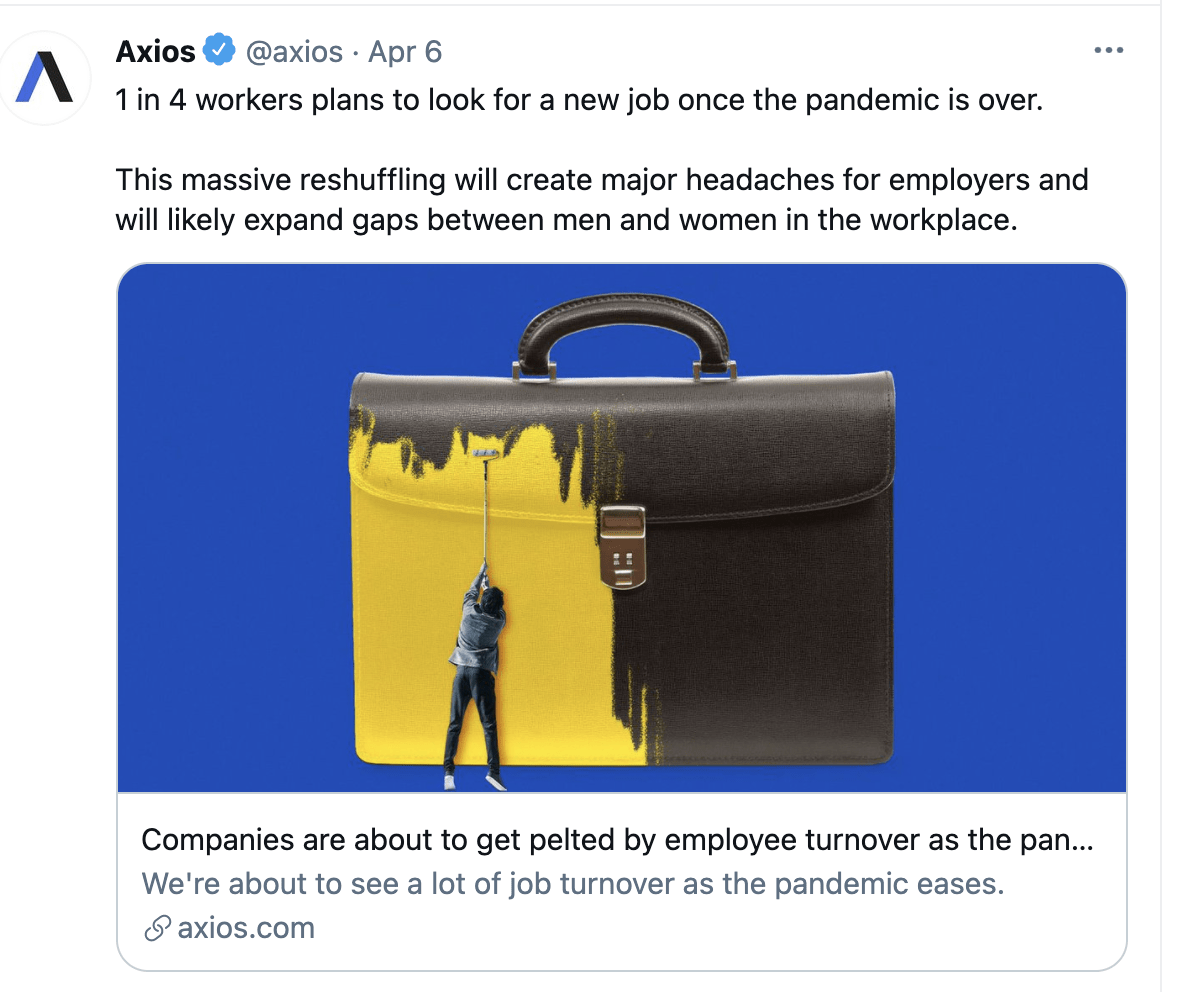
There’s going to be a TON of news coverage, hot takes, strong opinions, and purity tests on this stuff over the coming months. Assume as CEO that it will be impossible to retain 100% of your employees no matter what you decide. There’s going to be a talent reshuffling for the next 6–24 months IMO as employees decide whether their current employer’s workplace strategy is right for them or not.
And resist the urge to reduce this to assumptions like “equitable workplaces are those with the fewest mandates.” These choices are complex, often with unintended consequences. Flexible schedules more friendly for women? Unclear according to this WSJ article:
Denise Rousseau, a professor of organizational behavior and public policy at Carnegie Mellon University, said hybrid models appear to offer the benefits of both worlds. But they could inadvertently disadvantage women, who shoulder the bulk of caregiving duties and may be more likely to seek more home-based arrangements and miss out on professional face-time, she said. Any solution to one problem will raise other challenges, she said.
The President of Barnard College fears similar and notes it’s about systems of choices, not just a single decision:
So what should well-intentioned companies and managers do? If you think flexible work will boost equity, especially for parents, it is critical to consider what other policies and practices must be in place to advance this goal. Providing paid family and parental leave — as opposed to just maternity leave — and encouraging employees to take it is one example. Ensuring managers do not favor in-person employees for mentorships, in evaluations or for other opportunities is another.
So start thinking about what’s right for your stage of company, the type of product you build, the culture you’ve created, and then prepare for a lot of communication over the second half of the year.