Future of Work Software That Focuses on EQ Not Just IQ

Why The Move to Remote Has Accelerated The Need for New Tools

The first generation of SaaS was about single player workflows and data. The second generation added collaboration (aka multiplayer). And the third generation added ML/AI to reorganize/optimize those workflows based upon the intelligence of the computer, not the habits of the user. Not every industry and not every profession has moved through these generations in sync. Early adopter verticals — such as software development and tech sales — is mostly in Gen 3. Some of the largest markets including construction, health care, finance and agriculture are moving into Gen 1 and 2, with specific toes dipped carefully into 3. And my framework here also applies mostly to the US, with other part of the world ahead and behind the pacing I’ve suggested above.

Homebrew has invested into all three generations of SaaS mentioned here, and continues to do so with the previous 12 months including undisclosed seed rounds into promising teams working on agriculture fintech, health care backoffice automation and salesperson performance. But I also wanted to suggest there’s a coming Gen 4 of SaaS leaning heavily into EQ instead of IQ because I truly believe the Future of Work involves understanding emotions not just data.

When friends ask me to reflect on the impact of 2020–21 on startups one of the observations I shared is how dramatically the urgency increased around conversations that were more about culture, behavior and values than just strategy, financing and product. Especially during the second half of last year the convergence of the COVID pandemic, US political race and societal outrage over George Floyd’s murder, resulted in CEOs confronting a host of situations that weren’t on their roadmap.

In some cases these leaders wanted to be proactive in the moment. Other times it was their teams, customers or reporters probing for their POV. And regardless they wanted to be thoughtful, deliberate and consistent in how they, and their companies, engaged. So my conversations with these CEOs wasn’t about pushing my particular opinion on these matters or rushing them into a conclusion, but rather helping them focus what they were hoping to accomplish with their internal and external positions. I’m proud at the range of outcomes since they were honest and authentic, not performative.

Throughout these months one thing became very clear with all the leaders and managers I spoke with — they didn’t have the software tools to engage and understand their teams, their customers and other constituents at a deep emotional level. They had plenty of communication utilities which made conversations virtual but they didn’t have modern tools built with EQ in mind. So you had “Zoom Fatigue” and burnout and HRIS platforms designed for compliance not engagement. Thankfully I knew there were better options in development. How? Because we’d invested in them 🙂

Over the past 12–18 months another theme had started to coalesce in the Homebrew portfolio — Future of Work tools that were built with a combination of IQ *and* EQ. Gatheround in the teambuilding, education and collaboration space; Humu, smartly bridging the gap between strategy and action for your teams; Ethena for modern compliance training and behavior change; and Assembly in the lowcode HRIS market. Ahead of the extraordinary circumstances of the past year and a half, these founders had intuitively sensed and previously experienced the limitations of Generation 1, 2 and 3 tools. And while I don’t think they all agree with this market positioning, to me they represent the next wave we’re going to see in Future of Work tools, designed with tangible and intangible sense of how people are left feeling by the software they use, not just how productive they were. It’s still very early in this cycle but hybrid and remote work is pulling us forward with new types of communication, virtual HQs, and socialization needs. And software that remembers humans are the endpoints.

‘Inside Rounds’ Used to Be Bad. Sequoia & WhatsApp Changed Venture Forever

Why Their Multibillion Dollar Outcome Flipped The Script

Pre-2014: Insider Rounds Are The Funding of Last Resort

Post-2014: Why Are Insiders Letting This One Get Out?

When WhatsApp took $19 billion and joined Facebook, the industry headlines moved quickly from the buyout itself to Sequoia’s masterful funding strategy of the startup. After publicly leading a Series A, the firm put another $50m+ into the startup in two subsequent insider rounds, neither of which were disclosed publicly prior to the acquisition. Collectively a lot of other VCs closed their laptops after reading the news, put on their Patagonia vests and took a brisk walk down Sand Hill Road while wondering how to deal with this new reality.

What was the big change? A firm had led two successive ventures rounds into a portfolio company. And they were Offensive rounds, not Defensive ones!

Up until this point the idea that your previous round’s investors did the funding on your next round was pretty verboten and when it did happen, it was capital of last resort. Like, the startup couldn’t get a new investor to lead around at terms that everyone liked so insiders decided to do the round themselves — writing the termsheet and supplying some to all of the capital. This was typically a signal of company weakness, not strength. And the investors didn’t like to do it because besides the risk of doubling down on a company instead of spreading the risk to other new investors, it meant repricing the company that you had previously invested in. An insider mark was considered to be a less reliable estimate of actual value than a new investor offering to price the round (so LPs looked sideways at it, etc).

To be clear I’m not saying Sequoia/WhatsApp was the very first time inside rounds occurred that ended up benefitting the investors and the company so the VCs reading this can save their DMs to me about how they actually led an insider round prior to 2014. Nor am I suggesting that Sequoia was the first firm to lead multiple rounds for the same startup. But I am saying it was the biggest and baddest example of the game changing. There’s a reason that for a while after the deal, trying to do an inside round was called “pulling a WhatsApp.”

Now in 2021 we have a very different landscape. The larger multistage funds don’t hesitate to lead back-to-back rounds (or in recent cases like a16z/Clubhouse, back-to-back-to-back). And it’s not just a change in norms and increased fund sizes which has supported this transformation, it’s also the Opportunity/Growth fund phenomena.

Now so many multistage firms also have some sort of growth/late stage vehicle it’s also possible to split an investment over time between those funds. Basically you’re doing the Series A and or B out of the core fund and then the C or D out of the growth fund (more of less, round nomenclature across different situations is less consistent than ever). So the risk/reward profile of the earlier investment is in a fund aimed at those bets, and the theoretically less risky, but also lower returning (on a multiple basis) later stage investment is in its appropriate vehicle. This also often means that although you have the same firm leading multiple rounds it’s a different GP — the early GP prices the first round and the growth GP prices the second one. While it’s still under the same umbrella, you can imagine that these two individuals at least serve as a check and balance on each other. If the growth fund GP is simply marking up the deals of her colleague, to her disadvantage in the growth fund’s returns, she’d be working against herself.

There’s a lot of differences between VC 2021 and VC 2001, and the nature of inside rounds is one significant change that I rarely see discussed structurally. But it’s important!

Tech Reporters, You’re Being Played By Using “Oversubscribed” To Describe Successful Funding Rounds

Why I Cringe Every Time I Read This Word

I recognize this is an overreaction. But humans have their quirks and one of mine is I cannot stand when the tech biz press uses “oversubscribed” to characterize a startup’s funding round or a venture fund’s raise. Before I share why, let me just explain what it means and is intended to convey in a financial context.

When a founder or a VC claims their round was oversubscribed they’re signaling to you that they had way more investors competing to give them money than they wanted to raise. It has nothing to do with the size or terms of the actual raise, just the presence of greater supply than demand.

Ok so why is it foolish for tech reporters to repeat this somewhat cliche talking point?

  • It Leads To A Prisoner’s Dilemma/Race to the Bottom of Hyperbole: Well if every other company is saying they were oversubscribed then we should say it too. No, even better, let’s be specific and say something like “we were 5x oversubscribed for this round.” Yeah, that’ll show em. Until 10x oversubscribed is claimed by the next startup. And so on, and so on.
  • Counterintuitively, It’s True of Most Reported Rounds: If a startup or a fund can reach its targeted amount, it can be ‘oversubscribed’ with the next dollar of interest. In fact, at that point it gets easier to raise the incremental capital, not harder, because you’ve solved the social signaling issue by attracting all the previous investors. In a single raise, getting your first investor is harder than getting your 101st. This is especially true when the quality of previous investors is high. There hasn’t been a seed round Homebrew participated in that wasn’t ‘oversubscribed,’ especially after we committed and signaled to other investors it was, at least in our minds, a startup to back. And I’d reckon same is true of every other peer fund of ours. And every Homebrew fund has had excess demand as well.
  • It’s Easy to Manufacture By Playing Cute With Figures: “We set out to raise $10 million and raised $10 million” = not oversubscribed. “We set out to raise $8 million and there was so much demand we raised $10 million” = oversubscribed. They are the exact same fundraise and the press will cover them differently. Which is nuts! Especially since most VCs will tell a startup to not price themselves out of a round prematurely. That is, go in with a figure that’s slightly below the total you’d like to raise, or a range, and let the market move you up. If you want to raise a $15m Series A and you’re doing well, but not knock it down great? Pitch people on a $10–12m round and then as folks bite, move the round up a bit. Sometimes you won’t be able to take all the additional dollars without incremental dilution but you’ll still have a much better chance of getting to $15m without scaring away potential investors.

I don’t mean to pick on any publications or specific reporters. In Googling for examples of this trope I happened upon some of my favorite journalists, who write amazing and insightful stuff. I believe though that this is one of the areas that being on the other side of the fence provides clarity on just how silly a term it is. So let’s put a stake through the heart of “oversubscribed” and just let a fundraise be a fundraise.

“I Can Really See Us Leading This Funding Round” Isn’t a Term Sheet

Why VCs Are Always ‘Very Excited’ About Your Progress But That Doesn’t Mean Anything Until They Make an Offer

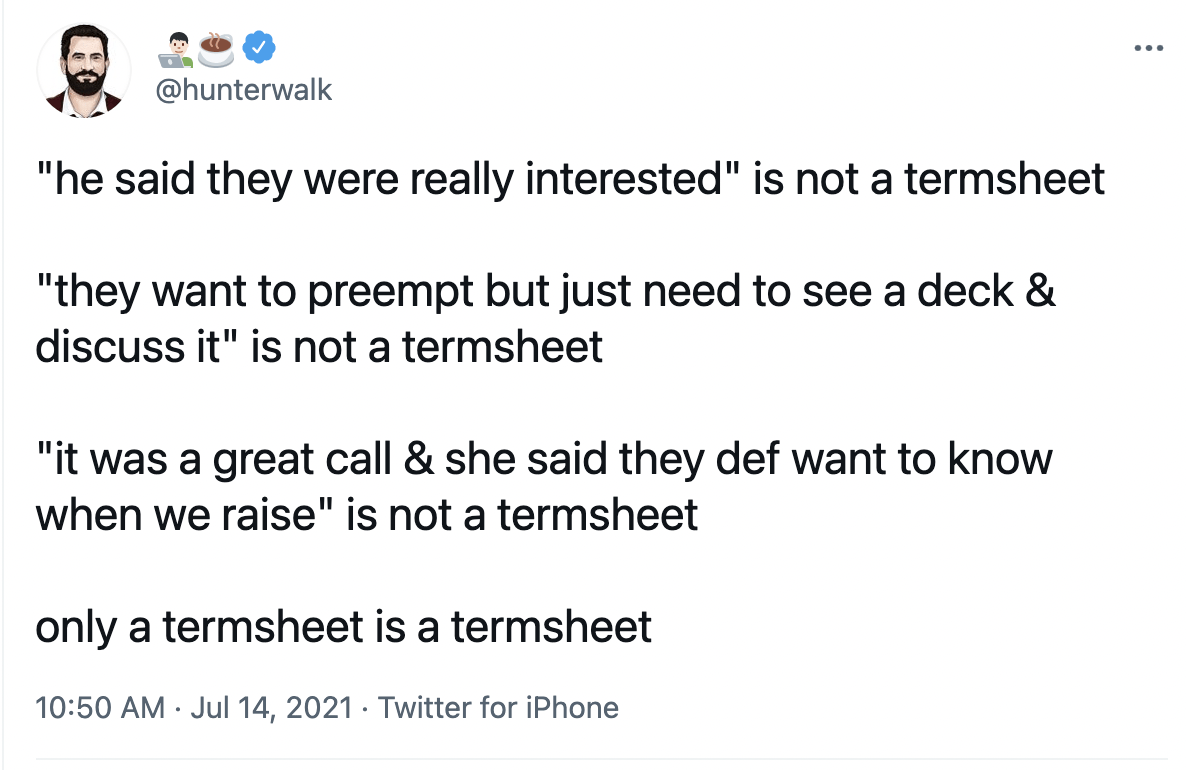
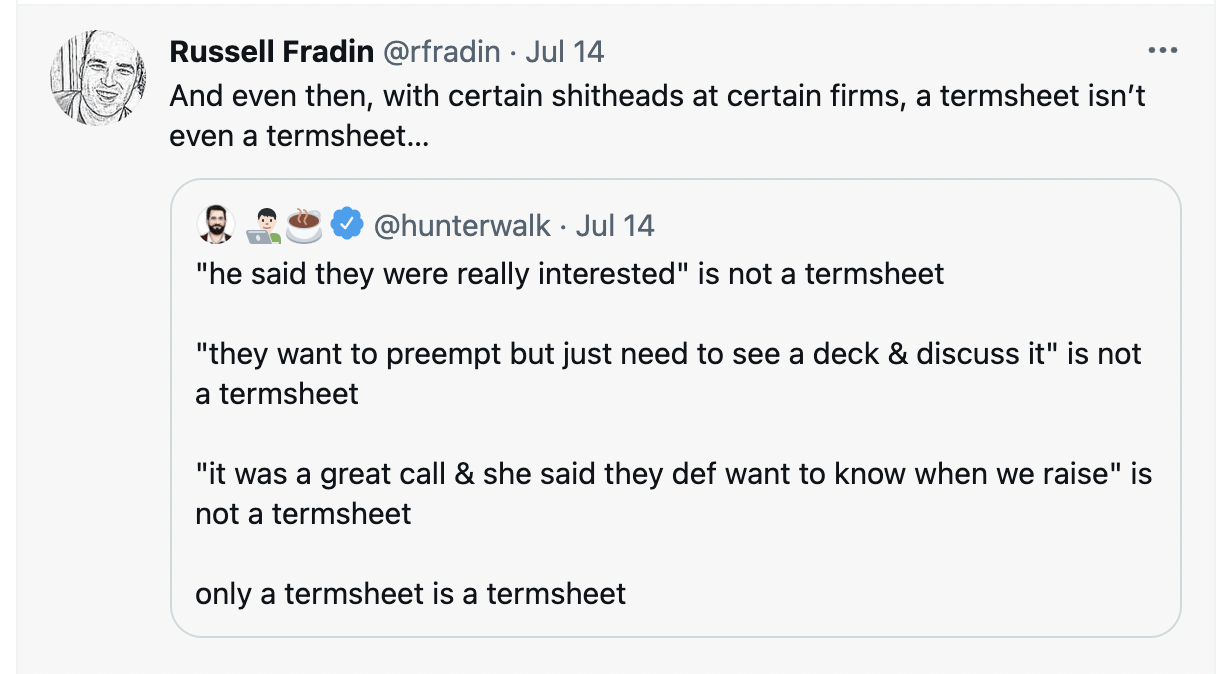
My job as an early stage investor includes translation services, specifically helping startup founders take what they are hearing from potential investors and providing a read on whether that VC is actually ready to make an offer. Quite often a CEO will share all sorts of positive comments and praise they heard from an investor, and I’ll remind them these statements aren’t termsheets. Simply put, only a termsheet is a termsheet.

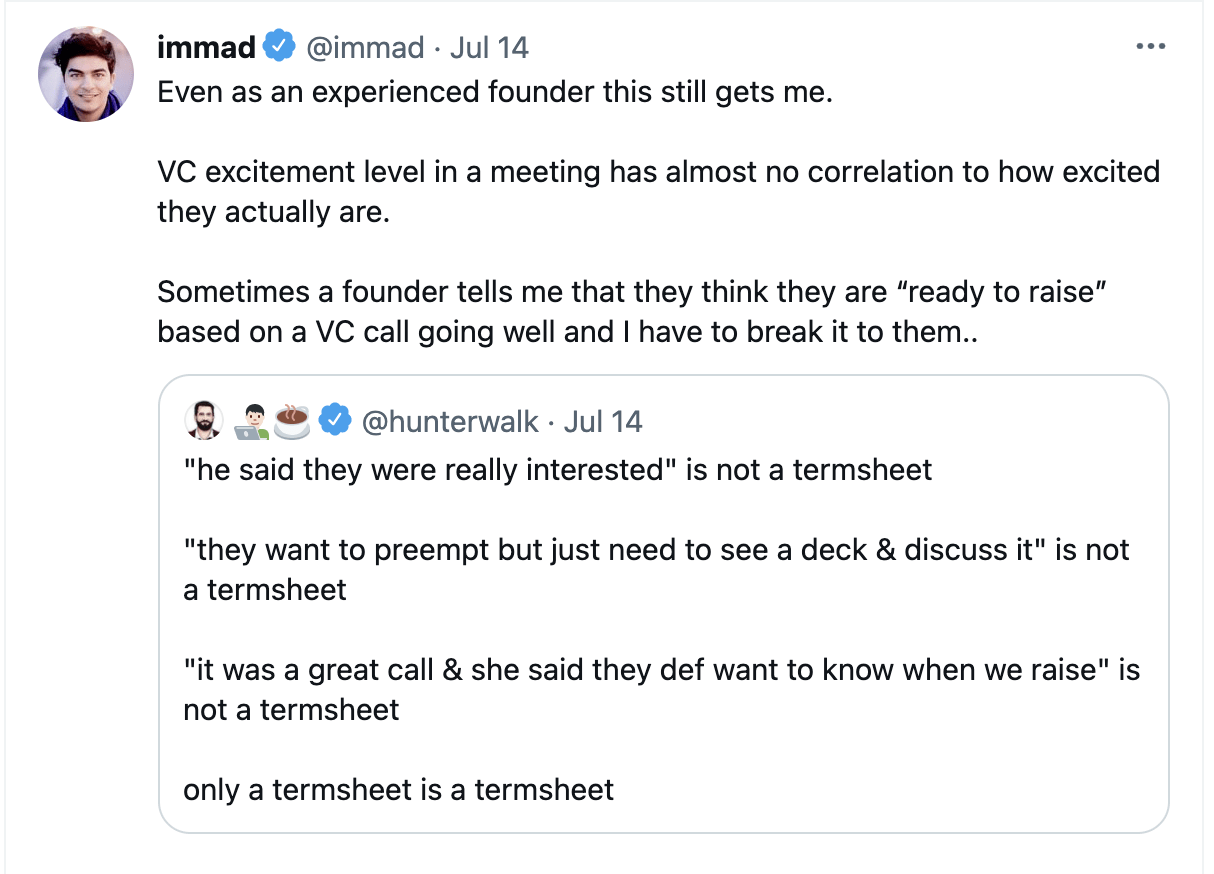
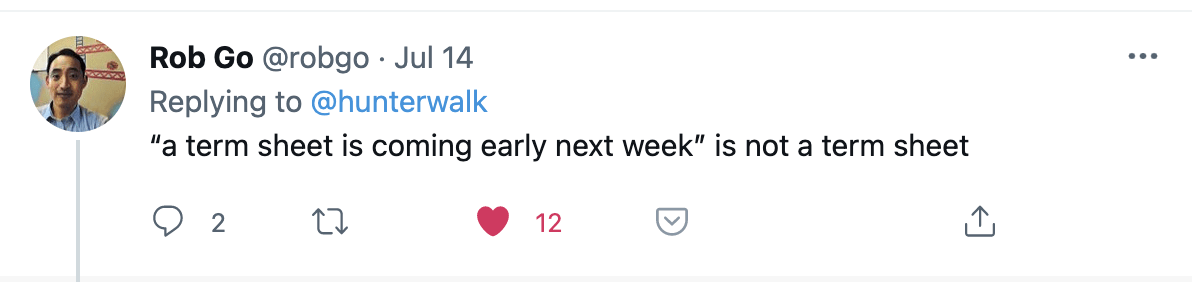
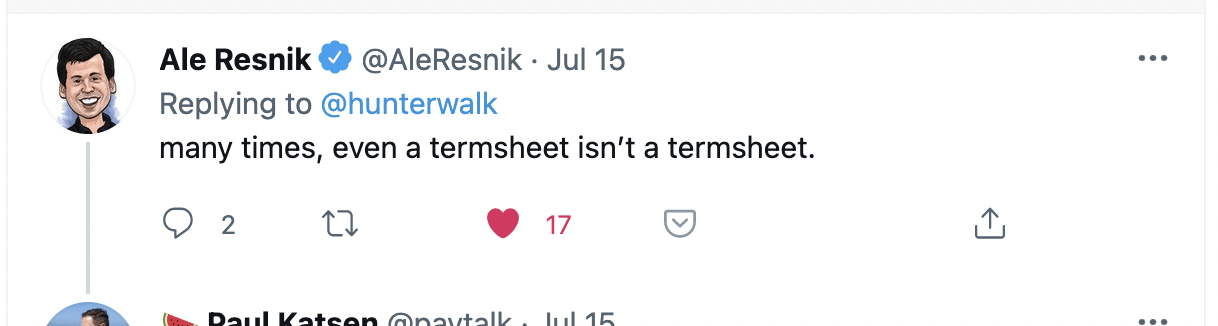
This reminder tweet set off a few good discussion threads that I wanted to capture and expand upon here.

Even experienced founders get ‘happy ears,’ not just first time founders

I definitely don’t blame founders for underestimating the distance between enthusiasm and a concrete commitment. VCs live in that world and have repeated experience. To the extent you trust your current investors’ feedback, you should *really* trust them when it comes to basic fundraising advice. Note: I understand that there are reasons to assume your investors are giving you advice based on their interests, not yours, but let me tell you, for the best VCs this isn’t the case. That’s not to say we’re always correct, but I will specifically tell a founder ‘and now I’m putting on my Homebrew hat’ when I have a POV that’s informed by my own needs as their capital partner versus what I generally think should be the company’s strategy. And I don’t take paths off the table for discussion that wouldn’t necessarily be my preferred choice.

Others VCs definitely know what I’m talking about

Everyone has experienced a termsheet that came with hidden surprises

Differences between the verbal offer and the provided termsheet; unacceptable clauses added; lots of noncommittal language ‘pending due diligence’ etc. We all have stories of a termsheet that didn’t pan out — either it never arrived even after it was promised. Or it was pulled for no reason. Or the investor didn’t have the money to close the commitment. And so on. This rarely occurs with established investors, because they know breaking their word is a reputation killer around our community. But it still does.

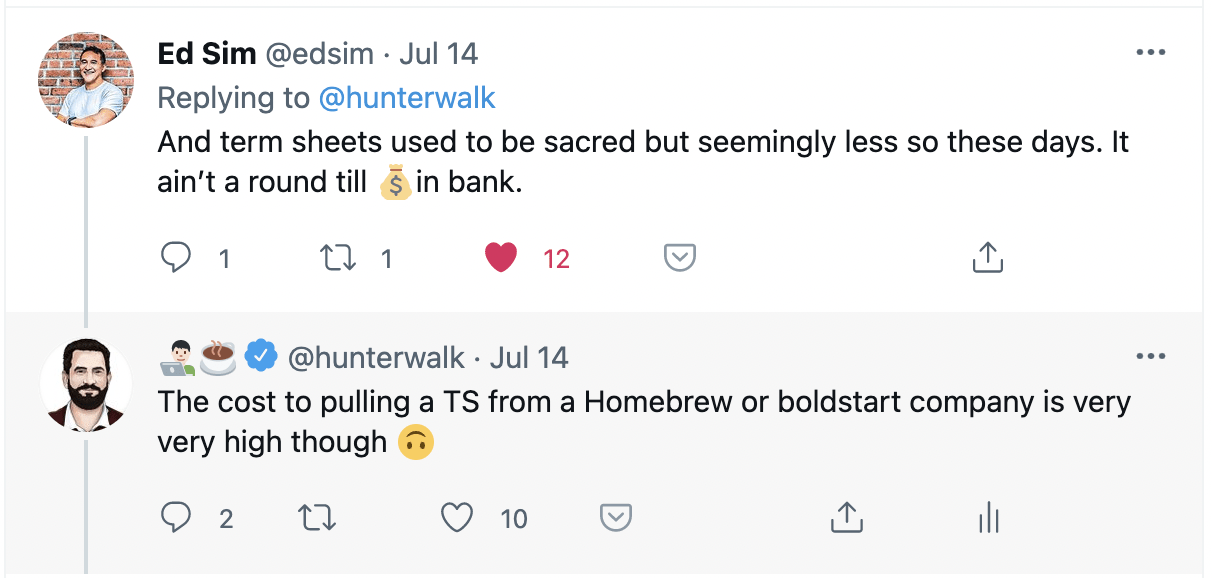
One of the benefits of working with someone like us, or Ed Sim at Boldstart, or one of dozens of other firms I’d recommend, is that you have some insurance against new investors fucking around.

Are VCs being duplicitous by always being ‘excited?’

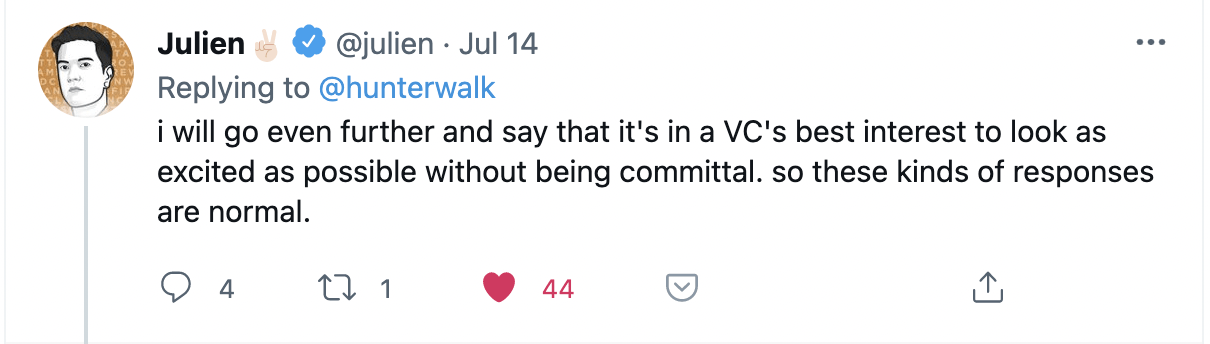
I value coinvestors who run quick, direct processes with our founders, but I expect a certain amount of interest that doesn’t convert, especially early in a process. Ahead of having to make a decision, it’s always in the interest of an investor to stay in the game. This isn’t unique to the dynamics of fundraising, but a ton of person to person interactions. Whether it’s a hiring manager holding some candidates at bay while they continue interviewing. Or simply me telling someone I’ll “try to attend their afternoon BBQ” as opposed to just saying no right away. I don’t generally hold any ill will towards these types of responses, especially when it’s ahead of, or during, a first meeting with a founder.

Can someone develop a reputation for being a Mr or Ms Maybe or overpromising and underdelivering? Sure. Satya and I have a list in our heads of GPs who we think do this and help our founders manage those conversations accordingly. But I really don’t think it’s outright duplicitousness, just the incentive gap between two parties: a founder wants to raise a round within a certain time frame and align all bidders, while an investor often wants as much information as possible and barring high conviction or a forcing function, will often move slower than the founder. The phases of fundraising, how to get to a first term sheet, and what to do once you’ve got an initial offer is probably a blog series of its own.

But end of the day, if you screw a founder, they’ll never forget

Addendum: When is a verbal or email offer as good as a termsheet?

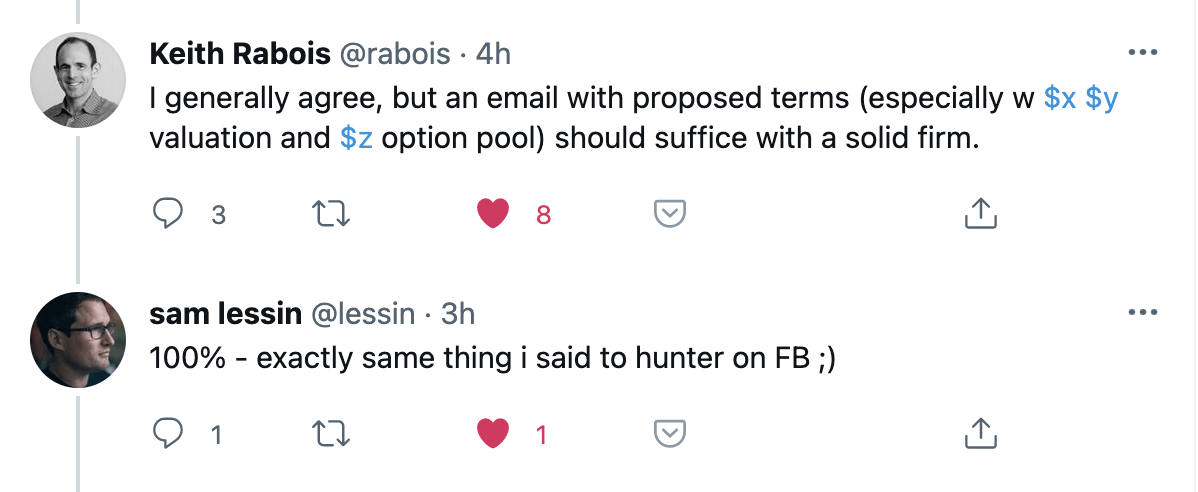
My friends Keith (Founders Fund) and Sam (Slow) pointed out that founders can rely on their offers without it being in a formal termsheet. I agree with Keith that an email from a Managing Partner at a Tier 1 fund with all major term components written out is 99% as good as a termsheet. I do not like verbals only — there’s too much potential for confusion is what was said, even in good faith conversations. The best practice I’ve seen is follow-up your call with an email that says something like, “per our discussion, we’re thrilled to offer ….” and include the major terms like Keith suggests.

When would I prefer a termsheet to an email, even with a Tier 1 fund?

A. When it’s a junior partner. Sorry, but if you’re just getting your feet wet at a fund, I want to know that there’s a managing/senior partner behind the offer.

B. When a founder is going to stop most of their other conversations as a result of the offer. Again, just good hygiene to have a termsheet in hand before you start slow rolling/canceling/opting out of other meetings. It’s company specific too. When I believe a startup is a slamdunk in its funding, we’ll use the first acceptable termsheet to eliminate 75% or more of the open conversations and really narrow down to a handful of firms the team is considering.

C. When there’s something non-standard the founders and GP have agreed to outside of the primary terms Keith mentions. This could include anything around board seats, secondary sales, and so on. Again, not because I don’t trust the GP but rather because it’s helpful to see it spelled out in legal language rather than short-hand intent. Maybe if your GP went to law school (again, hi Keith), I’ll be ok with just the email and its phrasing.

We Don’t Talk Enough About Money In Silicon Valley, Revisited

Things to Remember As You and Your Friends Get Wealthy

“Giraffe money.” That’s the phrase which stuck with me from Erin Griffith’s NYTimes article this spring about the latest set of wealth creating events in the tech community. To quote,

For Palantir, a data analytics company that went public in September, Feb. 18 was “giraffe money” day. That was the first day that current and former employees could cash out all of their shares after the company went public.

In a Slack channel for former employees called Giraffe Money — an apparent reference to wealth that can support casual giraffe ownership — many anticipated their windfalls by sharing links, mostly in jest, to absurdly expensive home listings and boats, one former employee said.

I never heard about giraffes after Google’s IPO, although reportedly one early engineer did buy a carnival-size ferris wheel. But that was back in 2004 and the trillions of dollars of wealth created since in startups, big tech companies and crypto makes earlier questions of extravagance seem quaint.

We are truly in a k-shaped economy and for those fortunate enough to be in the top arm of the K, it’s easy to benefit from being in the right place at the right time.

So I wanted to reshare a post I wrote suggesting that we actually don’t talk about money enough in Silicon Valley, at least not in the transparent and healthy ways that allow us to consider its impact.

https://hunterwalk.medium.com/we-dont-talk-enough-about-money-in-silicon-valley-no-really-e9335367e733

Reading it back 3 1/2 years later it still rings true for me personally. We are well-off and happy, those resources having played a significant role in mitigating the risks of the pandemic and the anxiety of a disrupted world. I still worry about the tension between wanting to provide my daughter more experiences and luxuries than I had access to as a child, but not distorting her values or work ethic. Some of the founders we backed in Homebrew’s first fund have realized — or will soon realize — outcomes that will net them hundreds of millions and perhaps even billions of dollars. And I’m thrilled for them and their teams.

More recently we launched an effort called Screendoor to help fund new emerging venture capitalists from underrepresented populations. The idea being that there’s economic opportunity in this segment that’s not being captured today, and there’s a chance to start a virtuous cycle where the investments they make will likely include folks in their networks, who will also hire people in *their* networks, and everyone succeeds together. Those of us who’ve had access to the right hiring manager, or cap table, or referral network have already put ourselves in a position to capitalize, but the pie can be expanded. It’s not about scarcity, it’s about abundance.

Ok, please read my earlier blog post and tell me what you think. I’m off to research how much it actually costs to privately own a giraffe….