Dark Side of the Moon: How We Unknowingly Encourage Bad VC Behavior

“Welcome to the dark side.” That was the standard line when people found out I was raising Homebrew, our new seed fund. It came from entrepreneurs or other investors, always said with a chuckle, like it was an innocent throwaway. Venture as the “dark side” of entrepreneurship is a really old joke. I have no idea where it originated but it’s so indoctrinated that folks like Mark Suster, an operator turned VC I really respect, includes it in his blog bio [update May 2014: removed as part of redesign].

My response? I’d just kind of look at them and say “Boy, you must know some shitty VCs if that’s what you think.” Yeah I know, I’m a major buzzkill.

Calling venture the “dark side” is bullshit but not because I’ve been a VC for all of three months and I’ve got thin skin. Rather I think this in-joke actually encourages bad investor behavior. Follow me on this one.

One of my favorite academics Robert Cialdini wrote a book called Influence which details how you can prime someone’s sense of self, and then they’ll try to make sure their actions match the construct you’ve helped them create. For example, if you ask someone “are you a good person” and they say “yes,” they’re more likely to contribute to a charity if your follow-up question is “do you want to donate? Good people give money to charities.”

So here’s my theory. When we sit around joking that venture capital is the dark side, we’re subtly making it permissible for an investor to be a jerk because we’re creating a popular stereotype and excusing the behavior which lives up to it.

Reminds me of the parable involving a frog and scorpion. Scorpion needs ride across a stream. Asks a frog. Frog says “but you’ll sting me.” Scorpion says “no because if I sting you, we’ll both die. Why would i do that?” Frog thinks about it and agrees. Scorpion stings frog. Frog wails “why’d you sting me, now we’ll both die!” Scorpion shrugs and replies “i’m a scorpion. it’s in my nature.”

Perpetuating the notion that venture = dark side allows a VC to shrug and say “it’s in my nature.”

Homebrew. We’re not scorpions.

Announcing: Homebrew, A Seed Stage Fund for The Bottom Up Economy

Earlier this year I wrote about leaving Google for something new. Well, newness has launched. Excited to share Homebrew, a seed stage venture fund created by me and my good friend Satya Patel. Homebrew seeks to back amazing entrepreneurs building in the Bottom Up Economy. What’s the Bottom Up Economy? Basically the concept that individuals and SMBs are leveraging technology to drive economy innovation and growth. Teams of 5, 50, 500 able to disrupt companies 10-100x their size. And the conviction that entrepreneurism is the solution to job growth and economic empowerment worldwide. You can read much more about our thesis here.

Personally, Homebrew is exactly what I want to be doing for the rest of my career. Working closely with extraordinary founders on ideas that stimulate and amaze me. Building an institution that goes all-in when it makes an investment. Create a way for other great operators turned professional early stage investors to join us in future funds. And expose my daughter to the dream of building something from scratch.

We’ve got a lot of work to do but as a wise man once said, I Love It When a Plan Comes Together

logo

Could the Real “Cheap iPhone” Just Be a Used iPhone?

Verizon, AT&T & T-Mobile are all announcing new wireless plans which make it easier for people to upgrade their phones annually. I’ve long imagined that Apple would eventually introduce a subscription package which guarantees you the latest iPhone hardware so long as you return the previous device “gently used.” Combine consumer demand for the latest & greatest along with rising enterprise-provided smartphones (not to mention people who are expensing their phones in a BYOD world) and you have a meaningful group of early adopters for whom this may be very attractive.

One implication of faster replacement cycles would be many more second-hand phones entering the resale market, not just from consumers themselves but from carriers who receive these as trade-in. In all the discussion about an affordable iPhone and the design concessions Apple would need to make to hit a <$100 pricepoint, is it possible that the real “cheap” iPhone is really a used phone resold? Think about it – Apple works with carriers to get 10-25% of customers on to the “Annual iPhone” plan. In return, they encourage the carriers to resell used iPhones (which aren’t subsidized) as many times as they can, with the carrier keeping the profit margin each time. Not crazy since the profit margin on a true “cheap” iPhone would be small for Apple anyway.

Apple plays the LTV game – get as many people on iOS as possible – and soak the early adopters for hardware margin while the rest of the economic pyramid adds value via developer network effects, iTunes purchases, etc.

Your iPhone today is someone’s cheap iPhone tomorrow.

Trying Out a New Job Before Committing

Job interviews are terribly insufficient for both sides – a candidate only gets to experience their prospective employer through a few select individuals and the hiring manager would actually rather observe interactions in a real job setting as opposed to a series of 45 minute discussions. That’s why last summer I wrote about the increasing trend of “Try Before You Buy,” where both parties figure out a way to work on a project together before mutually committing.

Well, it seems like “ditching the interview” is growing in popularity. A startup named GroupTalent has formed to put some structure around these arrangements. They’re focused first on programmers who work on a multiweek project for the employer. The project can be done outside of normal business hours (so you don’t need to quit one job to try out for another) and the candidate actually receives compensation on the order of $1-3k a week. Sounds pretty interesting, especially if the engineer is programming not in a silo, but can have some interaction with future colleagues (even if virtual). Would love to see this expand beyond coding and into other disciplines.

Basically, if you’re an executive looking for talent these days you need to be creative and thoughtful in order to win the best candidates.

Internet Etiquette: The Rights & Wrongs of Publicly Criticizing a Friend

Public arena vs private channels can be tricky. I’ve definitely been half-way done writing a blog post, only to delete or turn into an email upon realizing it would be more appropriate to handle offline. Publishing provides the opportunity for broader discussion/learning — you can make a case for common good — but sometimes at a cost by shining a harsher glare on a person.

Earlier this week Ben Horowitz of namesake VC firm a16z, wrote an analysis of Zynga’s recent management change. Called “Shared Command,” it blasted the way founder Mark Pincus and incoming exec Don Mattrick intended to divide responsibilities. Ben cautioned that he didn’t know the details but from all accounts it sounded like a terrible arrangement. As Ben wrote, “Mark reports to Don who reports to the board where Mark is Chairman. Who makes the final decision on products? If a product decision impacts revenue, who makes that decision?”

If you haven’t read “Shared Command” you really should. Typical of Ben’s writing it’s thoughtful, timely and about real people in real situations, not just hypotheticals. There’s no doubt that the tech community as a whole benefited from absorbing and considering his assertions. But something remained a little off for me, nagging while I finished it and then reviewed a second time. I realized it all tied back to the opening sentence.

“Zynga recently put a new management structure in place where Don Mattrick is the CEO and my friend Mark Pincus, the founder and former CEO, will be the Chairman of the Board and the Chief Product Officer.”

There it was. “My friend Mark.” Juxtaposed against the lack of a similar statement about Ben’s feelings towards Don, it suggested a direct personal tie between Ben and Mark. They are friends. As such I kept wondering why Ben didn’t just write this as an email and send directly to Mark or otherwise communicate his concerns privately? The Zynga management changes come at an important juncture for the company and certainly transitioning the CEO role is an emotional time for any leader. How does Mark benefit from having Ben publicly question the strategy while Zynga strives to improve investor sentiment? If the answer is “he doesn’t,” then did professional opportunity trump friendship?

Additionally, Ben published first on All Things D, then the next day on his blog. So that’s very much a sequence of events which suggests not only am I going to write something which could be viewed as critical, I’m going to maximize distribution.

At this point you might be thinking a two things:

a) Am I totally wrong about Ben’s motives and their implications

b) Aren’t I entering the same questionable territory that I speculate about Ben – publishing speculation that could have better been an email? [Hold aside the fact I don’t really know Ben personally.]

The answer to both is YES, which I why I decided to take the risk and make this public. In some ways it’s a lesser mirror image to the very question I wonder if Ben asked himself with regards to “Shared Command.”

Earlier this year I faced a similar situation in writing about the failure of video discovery startups. It was a stance I wanted to take for quite a while but needed to wait until I was no longer at YouTube. My reason was not to call out those who I thought were wasting their time but instead to get people building these companies to be thoughtful about their solutions. However I knew at least one friend – ShowYou CEO Mark Hall – was building a service I was essentially asserting would never be a big VC success. Since I was addressing a larger group of entrepreneurs than just Mark, I knew I wanted to publish the article, even if it bruised him a little. As a solution I approached him to write a response which I linked from my piece. I think our relationship is fine – maybe even stronger because of it.

So where do I end up on Ben and “Shared Command?” Left wondering was the message right but the medium wrong. It’s a situation I often consider myself – how to write thoughtfully but critically about people I consider to be a friend.

Update: Ben took the time to comment via LinkedIn

“Hunter, this is a good post and, to your point, I very nearly did not publish my post. Here’s why I did: – It was about shared command and not Zynga in that (as I pointed out in the post) I am not at all sure that the Zynga structure is actually going to be shared command. The Zynga anecdote made the post relevant, but certainly wasn’t the point and I think that the point is important. I’ve both worked in shared command structures and deployed them and they are never a good idea. I wish somebody would have said something a long time ago as it would have saved me quite a bit of grief. – If Zynga really is deploying shared command, then it’s hard for me to imagine this was Mark’s idea — shared command is almost always thrust upon you and never opted into — and the post will be helpful in assisting him to resolve what will become a far bigger problem than a blog post from me. Maybe all of that is wrong, but that’s how I thought about it.”

Should Instagram Turn Twitter Cards Back On?

Six months have passed since Instagram turned off their Twitter card support in order to drive clicks back to their website. Since that time both services have continued to grow and launched support for video products. Personally, my Instagram usage has gone down as a result but obviously Facebook is willing to take a short-term hit in order to build longterm brand and native service value.

But I think it’s worth asking the question: Should Instagram Turn Card Support Back On?

One idea: they should, but only for Instagram Video. Make the videos playable in line in order to try and deliver another blow to Vine’s popularity. My experience with YouTube suggests that you can still get people to click over to a video webpage once they’ve seen the video in order to watch it in larger, higher quality or see related videos.

If Instagram went this path do you think Twitter would approve the implementation? You can see Twitter saying “nope, it’s all or nothing. Support cards for both videos AND pictures, or not at all.” This could be done under the umbrella of wanting to create a consistent user experience for Instagram links.

What do you think – should Instagram turn Twitter Cards back on?

Waving Goodbuy: Facebook’s Big Whiff on Traffic of Commercial Intent

Commercial Intent almost never exists on Social Media.” What a crock. Every day my Facebook and Twitter feeds are full of discussions about music, fashion, electronics, travel and other highly valuable verticals. The fact these conversations aren’t directly attributable to sales conversion aren’t fundamental statements about social traffic, but rather continued product gaps in the underlying platforms. They haven’t designed great commerce experiences across the (a) identification of relevant discussions, (b) presentation of features to convert commercial intent and (c) ad products to present in context.

Let me use a recent personal example to illustrate:

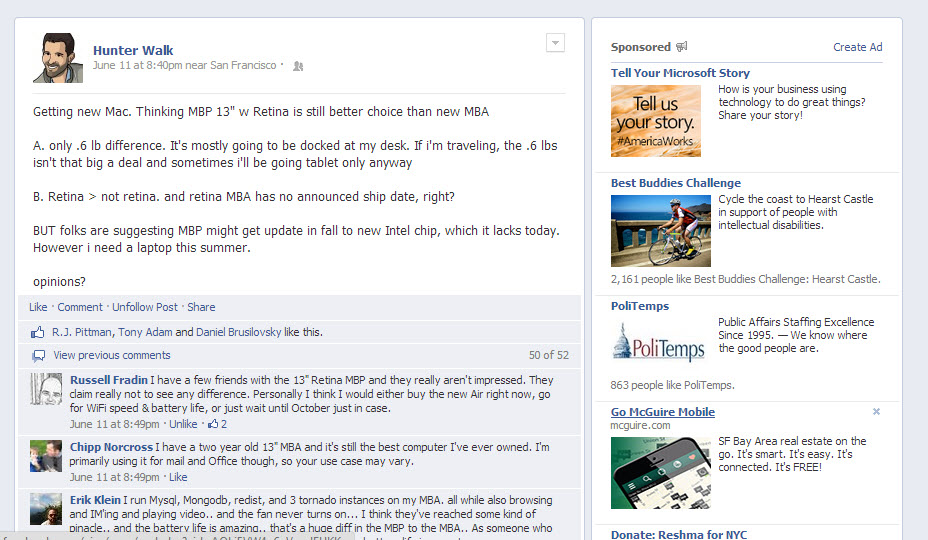
June 11th, I ask Facebook friends whether to buy a Macbook Pro or Macbook Air. I’m buying a new computer for my office. This is a $1000+ purchase. High value and I’m at a point of research. [for purposes of this discussion, i’ve set thread to ‘public’ but until this time was set to ‘friends only’]

June 11th-14th, 52 comments weighing in on things I should consider, including a few endorsements for the Chromebook Pixel. And a few friends stating they’re trying to make the same decision. Folks who weighed in included friends who probably fall into the “tastemakers & influencers” category – over 100k+ followers on Facebook, Twitter. In other words, the types of social referral that brands usually pay for!!!!

Despite an incredibly high density of product brand names in the discussion and words like “buy,” Facebook doesn’t seem to recognize this thread as any different than other types of posting. What could they be doing? Here are some ideas:

  • Aggregating all the similar product names into a “comparison” unit with pricing and availability from top merchants
  • Telling me which of my friends have liked “Apple” and suggesting I target the question to them via @names
  • Looking for other recent popular public posts or similar Facebook conversations from my social graph so I can read how those threads concluded
  • Giving me links to 3rd party research about these products on content partner sites like CNet, Engadget, etc

Instead I’m left to hope that some friends have pasted links into their responses and copy/paste any keywords into a separate browser tab for further research. This brings us into the world of ‘dark social,’ severing the direct referral attribution. Value leeches out of Facebook that they should be capturing.

For all intent & purposes, what I’ve done on Facebook is the commercial intent equivalent of searching MacBook Air on Google. Let’s see how they each blend ad products into this experience. You know where this is going, right?

Ads on Facebook irrelevant to the context of the discussion

Google inserts sponsored commerce results into the SERP

Here’s what I get from Facebook: “Tell Your Microsoft Story,” “Best Buddies Challenge,” “PoliTemps,” and “Go McGuire Mobile.” As Seth and Amy, might say, “Really?” I want to buy a computer. Please help me.

I realize these are hard problems to solve but there’s such upside available for both the user experience and Facebook’s monetization model, it’s the elusive Win-Win.

What am I missing? Am I overestimating the percentage of traffic that can be deemed of “commercial nature?” The complexity of the problem (I worked on AdSense so I know what’s hard and what’s easier here)?

Or does Facebook just like showing me elf boobs instead of Apple ads?

I don't like games or cartoon boobs. Stop showing me this.

I don’t like games or cartoon boobs. Stop showing me this.

The Why of Where I Write

I’m in the process of moving my blog to WordPress after many years on Blogger’s platform. Josh Felser asked why I selected WordPress instead of Tumblr or Medium. Similarly, in late May, Mathew Ingram and I had a tweet chat re: the question of where to post (or crosspost) items? This is total inside baseball but here’s how I think of my personal publishing today:

HUNTERWALK.COM: My blog, the flagship of my media empire 😉 Call me old-fashioned, but I like having my own dry piece of land, a URL to call my own that’s unlikely to experience changes in terms, UI, etc outside of my control. Blogger was my original software of choice because (a) I started on a Blogspot hosted domain years ago and (b) I worked at Google so it was easy to ask the Blogger team questions. Blogger has passed through the hands of many smart product managers but today isn’t moving fast enough for me, and much of its development seems focused on integration of G+, not remaining an open, neutral publishing platform. So I went looking for replacement software and settled on WordPress.

Why WordPress? Tried and true software built by a team I know and a company that has operated in a manner I respect. Under Matt, Toni and Raanan’s leadership they’ve been consistent and committed to their values – open source, distributed workforce. They’ve got a wide range of developers making 3rd party tools. I can look down the road and imagine them independent for many years to come. That’s important to me.

The major knock on WordPress is that it feels more like a CMS system than a beautiful, simple publishing platform, and that their mobile software still lags. Personally, I like being able to peer under the hood and see all the switches. Also, WordPress feels more suitable for longform, original creation, which is the majority of my blog posts (instead of just sharing someone else’s content with comment).

Finally, I should admit that because I know some folks on the team, I feel secure that if I encountered any troubles (especially with the migration from Blogger), I could get their attention, even given the relatively small size of my blog compared to their commercial partners.

What other publishing platforms did I consider?

  • Tumblr – Obviously great mobile product, simple toolset and upside of re-distribution ease via dashboard. We use Tumblr for a picture blog of my daughter to share with family. But overall didn’t feel like a place built around longform content creation. That’s not a knock, they’ve obviously been successful. Also, and this was before Yahoo acquisition, I knew their business would eventually need to mature and that felt unpredictable to me, so I was willing to sacrifice distribution and shine.
  • Svbtle – Never considered, nor invited. Although I’ve discovered many great writers on the Svbtle platform, I wasn’t interested in being locked into a single template. Plus their initial rollout rubbed me a bit the wrong way – felt very focused on tech velvet rope. Note, below I talk about my interest in Medium, which frankly could be called exclusive as well, since it’s invite only too. For whatever reason, and it might be as simple as I know Ev and don’t know Dustin, Medium didn’t have the same effect.

Ok, so hunterwalk.com exists, now powered by WordPress. Sometimes I crosspost (or even write original content elsewhere):

  • Medium – Ev invited me in pretty early (#humblebrag) so I posted once, but then stopped. The interface was certainly nice but the lack of comments/interaction left it feeling lonely. Recently though I’ve started crossposting ~1/3rd of my blog posts there based upon what I think the Medium audience would enjoy. Why? Because I’ve started to read a lot of great work on Medium so it feels like a community where I want to contribute back. I don’t promote my links there, so whatever readership I get, it’s organic or Medium putting their thumb on the scale. As a reader even more than a writer, I’m excited for the future of Medium.
  • LinkedIn – LinkedIn has really surprised me as a publishing platform and I crosspost when it’s a more business or professional development related piece. Somehow I’ve amassed 100,000+ followers so there’s usually good readership. Their commenting software is still horrible so I skip any interaction, which is a real shame. I hope they fix this, or maybe should just buy Disqus 🙂

Where Have I Stopped Writing?

  • Quora – It’s a valuable resource but once they broadened away from straight Q&A, it lost some focus

And I’m still conflicted about Guest Posts on Tech Blogs. In the past I’ve enjoyed writing for TechCrunch (many times), GigaOm (once) and PandoDaily (once). Additionally, ATD Voices, Wired and Fortune Term Sheet have re-run items I wrote. And Business Insider “aggregates” me every once in a while. It’s fun to reach new audiences but the way I write often doesn’t work well for guest posts – that is, I tend not to “news blog” (cover something that happened this week) and once a post is done, I just want to hit publish. I’ve known Eric and Alexia at TechCrunch for a long time and they’re pretty cool about fitting me in last minute when appropriate.

Okay, that’s a way too long explanation of why I write where I do. What about you?

My Autobody Shop Has a Sense of Humor

Email disclaimer signature from my autobody shop. Example of why social media is so great for small businesses because their voice can be much more personal than large companies. Imagine if this had to go through legal at Midas –> “We’re concerned you might be offending the French”

PRIVILEGE AND CONFIDENTIALITY NOTICE:
This e-mail is confidential and should not be used by anyone who is not the original intended recipient. It should not be photocopied, transmitted via walkie-talkie, CB radio, satellite dish, cable TV, overhead projector, smoke signal, Morse code, pig Latin, sign language, short hand, or any other means. This e-mail is under no circumstances to be translated into French. This e-mail is not to be ridiculed, mocked, judged in a competition, or read aloud in funny accents while wearing fake mustaches and/or hats of any sort including, but not limited to, bandanas. Do not taunt or provoke this e-mail. People taking certain prescription medications may experience nausea, dizziness, hysteria, vomiting, and temporary loss of short term memory while reading this e-mail. Please consult your physician before reading this e-mail. All vehicle models depicted in this email are 18 years old or older…or not. If you have received this e-mail in error, it’s probably because I am so consumed by self-importance that I wasn’t paying any attention to whom I addressed it.

You Are Not Your LDAP: Why Leaving Your Job Doesn’t Mean Losing Your Identity

hunter@google.com: From 2003-2013, it was a pretty powerful email address for me. I was the first “Hunter” to work at Google, so I got the six-letter name (the second Hunter went for retnuh@ — “hunter” backwards. Obviously he’s an engineer). And @google.com pretty much meant that any recipient would open the email whether they knew who I was or not — especially pleasurable since I joined Google from a lesser-known startup where you’re trying to convince the world you matter.

Often it wasn’t just an email address that drew attention. In the early Google years I had to be thoughtful about wearing logo gear outside of work. People would stop me on the street to tell me their Google search stories of triumph or failure, ask me about their website ranking, and, around the time of the IPO, make wild assumptions about my net worth.

When I started wearing YouTube clothing, the attention continued; it just shifted younger and to more aspiring rappers than webmasters. Everyone always had a favorite video to tell you about. And they assumed you knew it among the hundreds of millions of videos on the site.

The braggadocious email address and random interactions with strangers were cool, but the really sweet nectar came only as I started to take on more responsibility leading YouTube’s product team. The role connected me with notable technologists, investors, and media industry figures. YouTube founder Chad Hurley was also very generous with me, which resulted in invites to parties, meetings, and meals above my paygrade.

I started thinking about leaving YouTube in late 2010 once Chad announced that he was stepping down from the CEO role. I knew a phase of YouTube’s evolution was coming to a close and that it was likely best for both the company and myself that a different leader commit to the next part of the journey. But one of the things that kept me from making this change proactively was ego — the joy of being relevant because of my role. It certainly wasn’t just this feeling; I loved the team and the community, too, but in hindsight, there was definitely an insecurity that kept me from stepping away.

As the saying goes, “Man plans, God laughs,” and not too much later in the summer of 2011, a combination of things — some under my control, others not — caused me to leave my position. All of a sudden, the question I had asked myself — “Do I matter because of my job?” — was going to be answered. After taking the summer off, I came back to YouTube in a capacity of my own creation (thanks, Salar!), working in an area that had always been important to me: how YouTube is used as a platform for education, social change, and activism/free expression. This was the role I kept until I left Google roughly 15 months later (with another brief absence for paternity leave in 2012. Yippee!).

What happened once I vacated the throne? Did all of those folks who used to invite me to baseball games, dinner, and screenings disappear? The truth is that some did — most not because they were purely transactional relationships, but probably because we just didn’t have as much reason to spend time together. I’m sure there were some folks who now totally blew me off because I was no longer the gatekeeper to what they wanted, or had the fancy title that they could brag attended their event, but I emerged on the other side realizing that I had plenty to offer without the @google email address. And that confidence, plus some other serendipity, is what caused me to finally decide to leave and pursue…. [redacted for now 🙂 ].

So why am I writing this now? Not nostalgia for Google — I continue to admire the company tremendously and care about many of the people but have no interest in returning. Rather, I want to acknowledge my own struggles with separating “where I work” from “why I matter” and self-worth.

Careers are sets of decisions where you have the chance to emerge from the chrysalis every so often and show the world, show yourself, how you’ve evolved. You are not your org chart, your department budget, or your title. Don’t let success at a company prevent you from pursuing scary and wonderful new opportunities to build. It took me a little longer than it should have, but from the other side, it’s pretty awesome.

originally published on Medium